
Most solar installers steer clear of multi-tenant properties unless their state has a special program for multi-family buildings. It’s not difficult to see why: Malls, warehouses and apartment complexes have a reputation for eating up time and falling apart in the pipeline. Most contractors have one shelved multi-tenant project they’d rather not talk about.
But things are changing, and more companies are tackling these complications from different angles. It’s time to re-examine the multi-tenant solar market.
Why multi-tenant solar projects stall

A Sunrun apartment installation. Credit: Solar on Multifamily Affordable Housing – SOMAH
Two things seem to trip up multi-tenant solar. The first is the split incentive between the property owner who controls the roof and the tenants who pay the electricity bills. The property owner usually pays only for electricity used in common areas, while each tenant is responsible for the utility costs in their own space. That means the tenants, who would see the most savings from rooftop solar, have little say over whether a project gets approved on a shared roof. The property owner has less financial incentive to bother.
That disconnect becomes more consequential as electricity prices rise. The average U.S. commercial electricity rate increased nearly 5% from June 2025 to June 2026, making the potential savings from onsite solar increasingly valuable to tenants. Balcony solar, which lawmakers in more than two dozen states have introduced legislation to support, can help the occasional apartment-dweller with a sunny patio. However, it barely dents a building’s actual tenant load and does not resolve the underlying split incentive.
The second problem is managing how solar production is allocated and billed as tenants come and go. Differing lease terms and uneven tenant interest make it difficult to split that production across dozens of separately metered spaces. A solar system may operate for decades, but the tenant mix can change constantly, making long-term planning shaky. Even if a landlord agrees to be the energy provider, someone still has to send bills, track rate changes and answer tenant calls.
None of this is really about equipment or installation. It’s about who owns what, who bills whom and who’s still answering the phone five years from now.
A different approach to ownership and tenant billing
Due to these issues, few multi-tenant solar projects were developed for years. Now, some solar companies are finding success with approaches that address different parts of the problem.
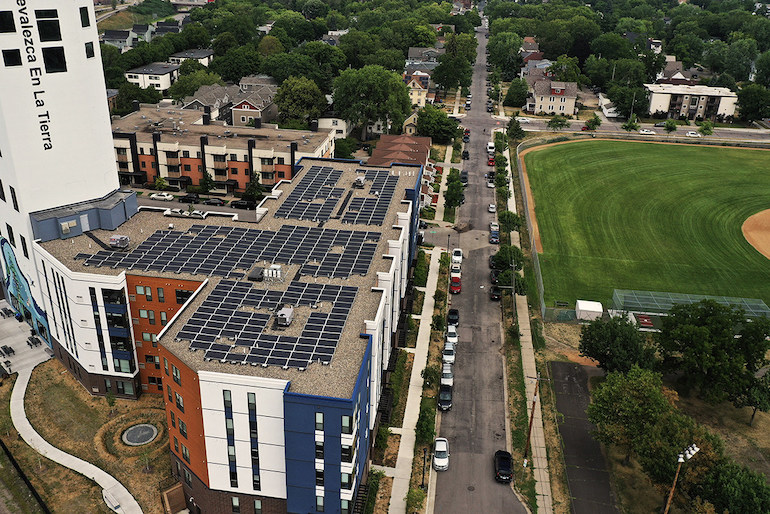
A solar install on community housing in Minnesota. Credit: All Energy Solar
For example, Allume Energy’s technology allows one rooftop system to serve multiple individually metered apartments. Solar developer Catalyze uses an integrated model in which it finances, owns and operates the solar installation, while the property owner earns rent without paying for or managing the solar project. King Energy uses a similar approach but combines the property lease with tenant enrollment and billing. It rents roof or parking lot space from the property owner, then finances, owns and operates the solar and battery system. The landlord collects rent without spending a dime, while tenants can choose to buy solar power at roughly 10% below utility rates.
King Energy has also developed a unique billing process. Instead of sending tenants a second potentially confusing invoice, it folds the utility and solar charges into a single bill. Both line items are shown so the discount is obvious. A small business owner could compare last year’s bill with this year’s and see only the logo and total have changed.
The company also does not perform construction itself, instead partnering with regional EPCs. Individual projects can be as small as 100 kW when part of a larger portfolio, although the sweet spot is above 500 kW. King Energy is not trying to compete with EPCs for installation or O&M work. It aims to serve as the financing and billing partner working quietly in the background, with its services white-labeled or co-branded as needed.
These are just a few ways companies are making multi-tenant solar more workable. With new technologies and business models, these projects deserve renewed consideration.
Deciding which shelved projects deserve a second look
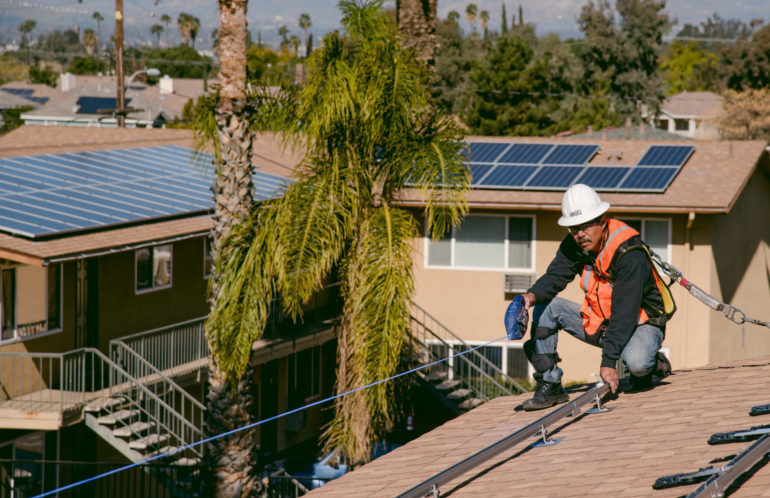
A solar installation on a multifamily complex in Loma Linda, California. Credit: Marissa Leshnov/Solar on Multifamily Affordable Housing
Before dusting off an old opportunity, one should consider a few questions.
- Who’s financing and owning the system?
- What’s in it for the property owner?
- How are savings split among tenants, and can they opt out?
- Who’s handling billing years down the road?
- Does any of this work under the local utility’s tariff rules?
A project is worth another look when there’s an engaged owner or REIT behind it, and it’s in a portfolio of properties rather than set as a single building. Strong candidates also have roofs with plenty of life left, reliable access to meter data and utility rules that support a workable billing model. It’s still worth walking away when ownership is murky, load data doesn’t exist, the roof needs replacing soon or nobody on the team is willing to manage billing and tenant turnover for the next two decades.
The bottom line
Multi-tenant solar still demands careful qualifying, and plenty of projects will stay too tangled to bother with. But maybe it’s worth re-examining shelved opportunities.
The hardware was never really the problem. What matters is whether the property, the utility market and the install team can support a long-term structure for ownership, billing and tenant management. The right team of players can make it happen.
Tim Montague is President of Clean Power Consulting Group, host of the Clean Power Hour podcast, and author of the forthcoming book Wired for Resilience: The Battery & Microgrid Playbook. With more than 1.8 million podcast views, he is a leading voice in the clean energy transition. A NABCEP PV Technical Sales Professional Tim brings more than 10 years of experience developing over 150 MW of commercial solar. He helps solar companies grow and improve profitability by combining deep industry expertise with practical business strategy. Tim serves on the Advisory Board of Luminous Robotics.

Tell Us What You Think!