
Researchers are using in-situ spectroscopy to watch lead-free tin-perovskite solar films form in real time, providing new insight into one of the technology’s most difficult manufacturing challenges.

Tandem perovskite/silicon solar cells in research. Photo by Dennis Schroeder, NREL
Perovskite solar technology continues to produce impressive laboratory results, but commercialization presents a challenge that receives far less attention than record efficiency: making high-quality films consistently. A solar cell that performs exceptionally once is scientifically interesting, but a manufacturing process must produce comparable results again and again. That challenge is particularly difficult for lead-free tin-based perovskites. Tin is an attractive alternative to lead in next-generation perovskite photovoltaics, but tin perovskites can nucleate and crystallize extremely quickly. That narrow processing window means relatively small changes during fabrication can affect film morphology, electronic quality and ultimately device performance.
Researchers at The University of Osaka and Kyoto University in Japan recently investigated whether better control of that crystallization process could improve both device performance and reproducibility. Rather than examining only the finished solar cells, the researchers used in-situ optical spectroscopy to observe what was happening while the perovskite films were actually forming.
Watching the film form
The research team investigated temperature-controlled anti-solvent engineering as a way to manipulate the crystallization kinetics of tin-based perovskite films. The researchers varied anti-solvent temperature across a broad range and combined the optimized process with pre-annealing passivation. The approach changed how the films crystallized and packed, helping suppress energetic disorder and non-radiative recombination. The result was an increase in power conversion efficiency from 3.50% to 9.12%, along with improvements in operational stability and reproducibility.
The significance, however, is not that 9.12% represents a new efficiency record. Other research groups have demonstrated tin-perovskite devices at comparable or higher efficiencies. What makes this particularly interesting from a manufacturing perspective is the attempt to understand and control a notoriously sensitive fabrication process. To observe that process, the researchers performed in-situ UV-Vis absorption and photoluminescence spectroscopy inside a nitrogen-filled glovebox. A StellarNet BLACK-Comet spectrometer monitored UV-Vis absorption, while a StellarNet SILVER-Nova spectrometer measured photoluminescence. These complementary measurements provided information about the material as it evolved during processing rather than simply characterizing the film after fabrication was complete. A measurement made after fabrication shows what was made; an in-situ measurement can also help determine how it was made.
Why crystallization control matters
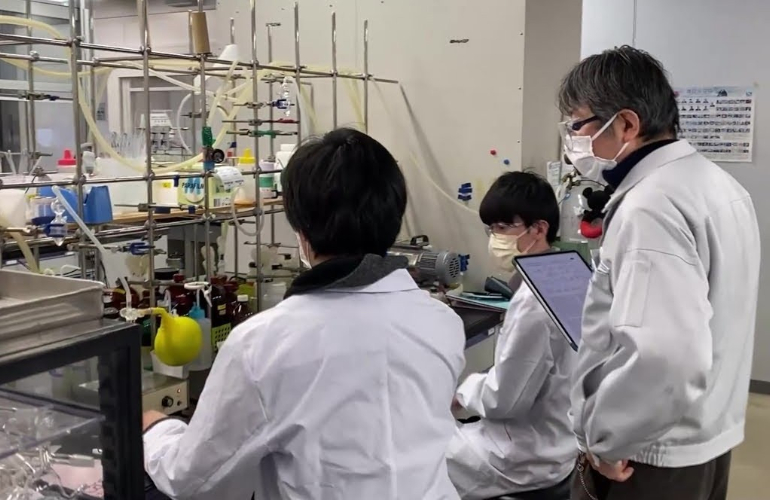
The research team in Japan.
The Japanese research is part of a much broader effort to make perovskite fabrication more controllable. Researchers in Europe have investigated controlled crystallization during slot-die printing of tin-perovskite solar cells, including the use of in-situ optical spectroscopy to study crystallization and optimize printing conditions. Other teams have used solvent chemistry, additives, vapor treatments and other approaches to regulate nucleation and film growth. The specific techniques differ, but the underlying problem is similar: emerging photovoltaic materials cannot move successfully from laboratory demonstrations toward scalable production unless researchers understand the relationship between processing conditions, film formation and final device performance.
This is where real-time optical measurement becomes particularly useful. Absorption spectroscopy can track changes in the material’s optical absorption as the film develops, while photoluminescence provides complementary information related to excited-state behavior, defects and non-radiative recombination. Monitoring both during formation gives researchers another window into a process that may otherwise be evaluated primarily from the finished film. Compact fiber-optic instrumentation also allows these measurements to be integrated into environments where the materials are actually processed, including controlled-atmosphere gloveboxes and experimental deposition systems.
From laboratory measurement to process understanding
In-situ optical monitoring is already established across a variety of thin-film and deposition applications. Applying those techniques to perovskites is particularly compelling because crystallization can occur quickly and the relationship between processing and device quality is so sensitive. This does not mean that laboratory spectroscopy alone solves the perovskite manufacturing problem. Commercial production introduces entirely different challenges involving deposition area, throughput, environmental control, equipment design, material stability and quality assurance. But the underlying principle is relevant to manufacturing: measure the process while it is happening rather than relying exclusively on inspection after it is finished.
For perovskite photovoltaics, that could mean identifying optical signatures associated with desirable film formation, understanding when processing begins to deviate from an optimized condition, and ultimately developing larger process windows that make fabrication less sensitive to small variations. The transition from laboratory discovery to commercial manufacturing often depends on exactly this type of knowledge. Researchers first determine which process variables matter, then establish how those variables affect the material, and eventually translate that understanding into manufacturing controls.
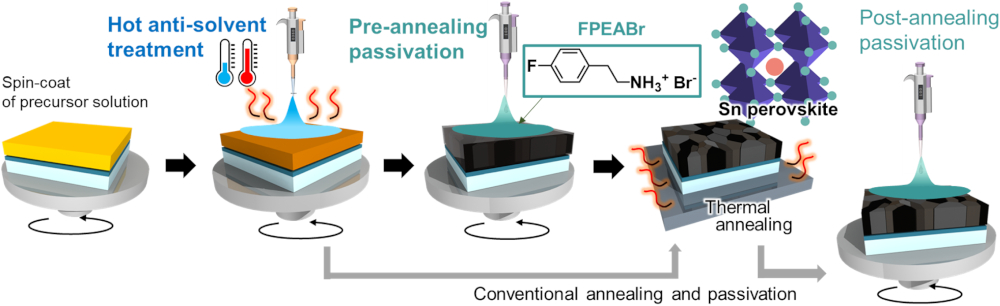
From the Osaka and Kyoto researchers: Schematic of hot anti-solvent treatment and pre-annealing passivation to decouple the kinetic fragility and transfer to temperature-controlled nucleation and growth (the black arrows). The process represented by the grey arrows is conventional post-annealing passivation.
Why this research stood out
 The University of Osaka and Kyoto University research has been selected as the first-place winner of StellarNet’s 6th Annual Spectroscopy Application Challenge, with the winners announced today. The annual challenge recognizes researchers finding innovative ways to use spectroscopy to answer scientific and engineering questions. This work stood out not simply because spectroscopy was used to characterize a high-performance solar material, but because optical measurement was integrated directly into the investigation of how that material forms.
That distinction is important. The researchers were not just asking how efficient the finished solar cell was; they were investigating what happens during fabrication that determines whether a high-quality solar cell can be produced consistently. For tin-based perovskites, solving that problem may ultimately be as important as achieving another laboratory efficiency record. As perovskite photovoltaics move closer to commercialization, researchers and manufacturers will need better ways to connect processing conditions with material quality and device performance. Real-time optical measurements provide one way to build that connection, and watching the solar cell form may prove just as important as measuring its efficiency after it is finished.
Research reference
Tingting Liu, Ryosuke Nishikubo, Chien-Yu Chen, Atsushi Wakamiya and Akinori Saeki, “Temperature-controlled anti-solvent engineering enables the fabrication of reproducible and stable tin-based perovskite solar cells by decoupling the kinetic fragility,” Journal of Materials Chemistry A, 2026. DOI: 10.1039/D6TA03298B.




Tell Us What You Think!