
Legislation that could legalize plug-in solar is active in every corner of the United States. Thirty-five states and D.C. have enacted, passed or are currently deliberating bills concerning plug-in solar, according to a chart maintained by Canary Media.
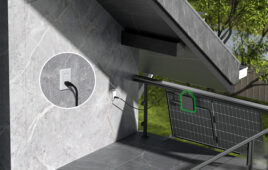
Colloquially known as balcony solar, or legally known as “portable solar generation devices,” this scale of photovoltaics is closer to something purchased off the shelf rather than commissioned and built by specialized contractors. Someone living in a state where this is permitted can acquire a plug-in microinverter and a few solar modules (depending on the microinverter’s wattage rating) and literally plug the inverter into an AC outlet in their home.
The most recent state to pass a related bill is California. Bernadette Del Chiaro, senior VP focusing on California at the Environmental Working Group (EWG) and former executive director of the California Solar & Storage Association (CALSSA), spoke to Solar Power World about the kind of advocacy behind these plug-in solar bills and how the technology could catalyze the larger solar PV market.
SPW: What is EWG’s interest in balcony solar specifically?
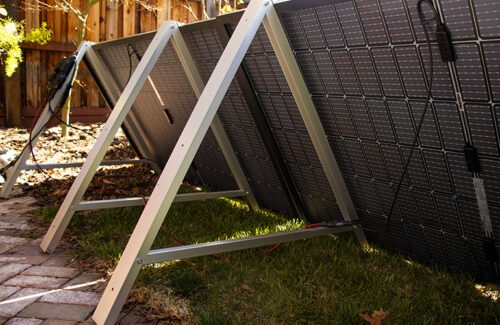
Plug-in solar goes by many names, including “backyard solar,” because the portable PV systems can operate in many different places. Credit: Bernadette Del Chiaro/Environmental Working Group
Del Chiaro: Broadly speaking, our energy supplies right now in America are actually toxic. When you think about EWG’s place in the world, where and how we get our energy is causing massive public health issues. In California, you add another wrinkle to this, and that is with increased heat, with climate change, California’s extreme heat days, that’s another public health threat, and people need access to affordable electricity. If you put those two together, there is a clear mandate for us to care about our energy supplies as much as we care about what kind of food is being sold in the grocery store and what kind of cleaning products are you bringing into your home. Energy is something that either comes into your home or you create it yourself, and it can either be toxic or expensive, or it can be healthy and affordable. If you go from there, balcony solar is an obvious solution.
There have been a handful of states that have permitted plug-in solar. Is there any significance to that happening in California?
Absolutely. Kudos, first off, to Utah. I just love that Utah was the first out of the gates. The whole story of Rep. Raymond Ward (R), this pediatrician by day and legislator by night, who read an article about balcony solar in Germany and said, “I should do that here.” He just worked it himself and got his colleagues to support it. And then people like me read about it and it opened our eyes. We said, “oh my God, we’re going to do that here.”
California was the first state to introduce legislation after Utah, but we were, at least so far this year, the last to pass it because our legislative sessions are just so long. It’s not really a function of too much delay, though if we had no utility opposition, we could have gotten it to the governor’s desk much sooner.
What oversight is there for something like plug-in solar?
The goal is to have no official government oversight. The vision is to have no utility oversight, no utility control, no local city building department, no building permit control and certainly no restrictions from your HOA or landlord. Those are the places that you can traditionally see these types of technologies be restricted or controlled. The whole idea behind these bills is to place all of the control and restrictions onto the manufacturer to make sure that the manufacturer is selling something safe for consumers.
If you step back and think about it, that’s the case with every kind of electronic device, for the most part, that is sold in the United States. It’s an appliance. That isn’t something that needs a building modification, right? So, it’s all UL certified. That’s how we do safety in America for basic common consumer products that are just appliances. We’re trying to get out of the building modification and interconnection with the utility that the rest of the solar industry needs to be tethered to and get it more into the world of this is a simple appliance.
Obviously, with a rooftop system, even though we all want to cut red tape, at the end of the day, you are drilling holes into the roof. You are making a permanent modification. If you’re net metered at least, the whole intention is to interact with the grid. We ought to have interconnection requirements and to have building permits similar to an HVAC system. If you had a portable air conditioner, which those do exist, you don’t get a building permit for that. You just plug it in. But if you’re going to install a permanent HVAC system, then you need to get a permit because you’re making some pretty big structural changes to your home.
How does balcony solar actually work?
It took me a minute to get my head wrapped around it too. The biggest thing is that electricity does not have a direction. It doesn’t go up, down, left, right, diagonal. It doesn’t care. It doesn’t have a forward direction. We just think of it as having a forward direction because for 150 years the source of electricity has been a power plant and then it is flowing in one direction toward your refrigerator. But it’s just like water in a pipe. It just flows to wherever there’s low pressure. So, that low pressure is the opening of a faucet or the plugging in of a computer. That’s what creates the low pressure and the electricity flows in that direction. So if you get your head wrapped around that, and then you have your head wrapped around that even a rooftop system — it ties in at the meter box, at the sub-panel — but at the sub-panel, it then distributes the electrons, which flow through the same exact wires in your home that all of your devices and appliances are plugged into.
Your home is not electrified any other way than through those same wires inside the walls. It’s the exact same physics. It’s just one is at the panel and the other is at the little outlet. The electricity doesn’t care. It just finds a wire and it’s happy to flow.
Initially, SPW didn’t know how to cover balcony solar, because we write for solar contractors. How does this affect people working in solar installation?
This is both Bernadette talking to you as the former executive director of CALSSA and then also Bernadette a consumer advocate. When I first heard about it in Utah, I made a few calls to my friends at CALSSA. All of them were enthusiastic about it. I do use those guys as my sounding board. Their instincts and my instinct and what I think will absolutely be the case is that this is like a gateway drug, and contractors all around the country and the world, frankly, should sit up and take notice and get really excited about this because what we’re just letting more people into this world of solar photovoltaics. We’re expanding our universe. We’re not shrinking it.
When they start seeing how much money they’re saving, and then if they have a suitable roof, maybe they’ll say, “I want to go bigger than this. I don’t want to just offset 10% of my bill. You know, I want to offset 100%.” When those renters move and finally get into their own single-family home, if that is still a possibility in our economy, they’re going to have experience with solar. They’re going to go, “I’m going to go bigger now that I have a bigger home.”


The Plug In solar inverters are smart and constantly assess grid voltage and frequency, then adjust their output to match frequency while slightly exceeding grid voltage, thus becoming the primary supplier for current draw, up to the output rating of the inverter.
Without this feature, plug in doesn’t work for the home “grid network” as a whole.
This is all set for rapid development as smart breakers and smart panels begin mass conversion, along with POCO “smarter” meters to communicate with individual circuitry components inside your home.
Plug In laws are a good scratch of the surface for this new phase of user power generation, manufacturers/suppliers are already gouging consumers by pricing systems into the $1000’s of dollars for 1200w (optimum max per hour of daylight hours) of supply, for only one leg of a standard 240v household, running as much per watt as a permitted and hard installed system.
Watch this space.