
An inverter’s role in a plug-in solar project is functionally the same as in an interconnected solar project: it converts DC to AC power. Where it differs is how much power it can handle and how it’s interacting with the grid.
A residential solar project is tied into a dedicated branch circuit on the home. These arrays operate at higher voltages (240+ V) than plug-in solar systems. If a residential PV project is interconnected, then the owner is compensated for the power it exports to the grid.
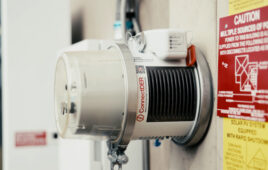
A plug-in solar system uses a microinverter that is literally plugged into a common GFCI outlet. These microinverters are rated at about half the voltage as those used in an interconnected array. The power they produce is used immediately within a home if there’s demand for it. If not, it flows to the grid.
“I come from a DIY background, and I’ve always been a big believer that solar is not as complicated as people think,” said Doug Hewitt, North American director at APsystems. “This completely simplifies it. We need to build more products like this — where it’s more easily accessible for people to go solar.”
Coming to America
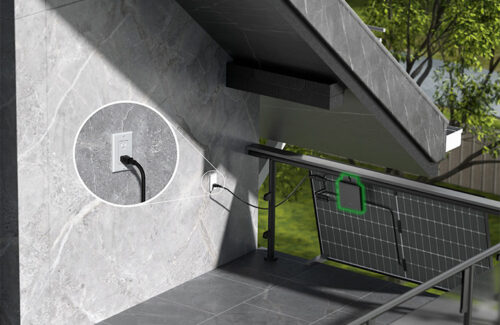
A rendering of a HiFlow plug-in microinverter from Hoymiles. Credit: Hoymiles
Plug-in or balcony solar technology arrived in the United States after legislation permitting its use was passed in Utah last year. Since then, many other state legislators have written plans to legalize these portable solar systems.
They were first popularized in countries where residents are predominantly renters and cannot install rooftop solar on their homes. In 2024, German residents were using more than 500,000 balcony solar systems, according to a story published by Grist. That number has reportedly more than doubled since then.
Inverter manufacturers Hoymiles and APsystems were already producing microinverters for the global balcony solar market before its advent in the United States. Recognizing its popularity abroad, the companies began adapting their inverters for U.S. electrical standards once balcony solar bills started being passed.
APsystems produces the EZ1 microinverter for plug-in solar applications. It is rated for a maximum of 900 V, has two channels for maximum power point tracking (MPPT) and comes with built-in system monitoring. The microinverter is designed for connecting to two modules (up to 660 W total), but with some adaptation can connect to more modules if they have lower wattages.
“The market is telling us that people are actually really interested in this,” Hewitt said. “It’s giving everybody a chance to go solar. I think it’ll be huge.”
Hoymiles manufactures a series of microinverters for the plug-in solar market called HiFlow. These microinverter models range from 280 to more than 650 W. Each HiFlow unit has one MPPT channel but can be connected to multiple modules. The microinverters can be used in sequence for a maximum system rating of 1.2 kW.
When legalized, plug-in solar is being treated more as an appliance than a modification. Having rooftop solar installed on a home falls under a similar permitting parameter as replacing a furnace or air conditioning unit. A plug-in solar microinverter is simply plugged in and sends power directly into the home through that electrical outlet without any modifications. The only other consideration is where to put the modules.
Plug-in solar microinverters are in a similar class of product safety standards as other home appliances. In January, UL Solutions published a new testing standard for “interactive plug-in PV,” UL 3700, to address safety concerns for how these microinverters interact with electrical outlets, preventing touch-related shocks and overloading home circuits. UL 1741 also applies to plug-in microinverters, which established a cybersecurity standard for inverter-enabled distributed energy resources.
What does plug-in mean for solar at large?
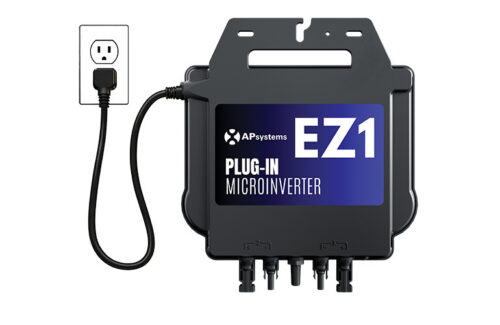
A product rendering of the EZ1 plug-in microinverter from APsystems. Credit: APsystems
Perhaps the largest difference between rooftop and plug-in solar technologies is the cost. Balcony PV systems are significantly cheaper than commissioning a solar installation on a home, but they also only produce a fraction of power. But any amount of self-produced power is still electricity not bought from a utility.
Balcony solar’s accessibility has led companies like APsystems to set up consumer-facing webstores for their microinverters and accessory components.
“I truly believe that the market will continue to move toward DIY,” Hewitt said. “Losing tax credits and having the industry being kicked in the you-know-what this last year, solar still makes a lot of sense. People being able to buy their own equipment and being able to install it can make a difference.”
However, Hewitt believes that plug-in solar has its role in solar installation. He sees potential for it in project repowering. Technicians returning to an array in need of updating could supplement lost power from underperforming or degrading modules with a plug-in solar unit.
“Most everybody needs more electricity nowadays,” he said.
Plug-in solar is still new to the United States. As more states pass laws permitting this solar technology, the cost of electricity continues to rise here, as does the cost of homeownership. Plug-in solar could introduce American renters to photovoltaics while other styles of these systems remain out of reach.
“The U.S. has a larger addressable base [than Germany], higher electricity rates in many states and now nine or 10 states with plug-in solar laws and more on the way,” said Sean Wang, North American president of Hoymiles. “Hoymiles sees the U.S. ceiling as higher than Germany’s, not just a repeat of it.
“The best answer to the U.S. energy crisis isn’t a complex grid, but an accessible technology that puts power back in the hands of everyday households,” he continued.


So very true, and on point. The only real way is a separate receptacle 15 or 20 amp circuit. Not way to do in an apartment / condominium complex.
Hewitt is right that this simplifies things, and the voltage point in this piece deserves more attention than it usually gets. These microinverters run at roughly half the voltage of a grid-tied unit, and that cuts both ways. Same watts at 120V means double the current you would see on Europe’s 230V circuits, which is why Germany’s 800W cap is closer to 400W worth of ampacity here. Utah’s 1.2 kW ceiling is landing on 15 and 20 amp shared branch circuits the NEC never contemplated backfeeding.
The failure mode the marketing skips is breaker masking. Plug 1,200W into the first outlet, run heavy loads two outlets downstream, and the panel breaker only sees net current while the wiring in between carries the full load. IT WILL NOT TRIP. That is why UL 3700’s overload monitoring matters more than the convenience of the outlet.