
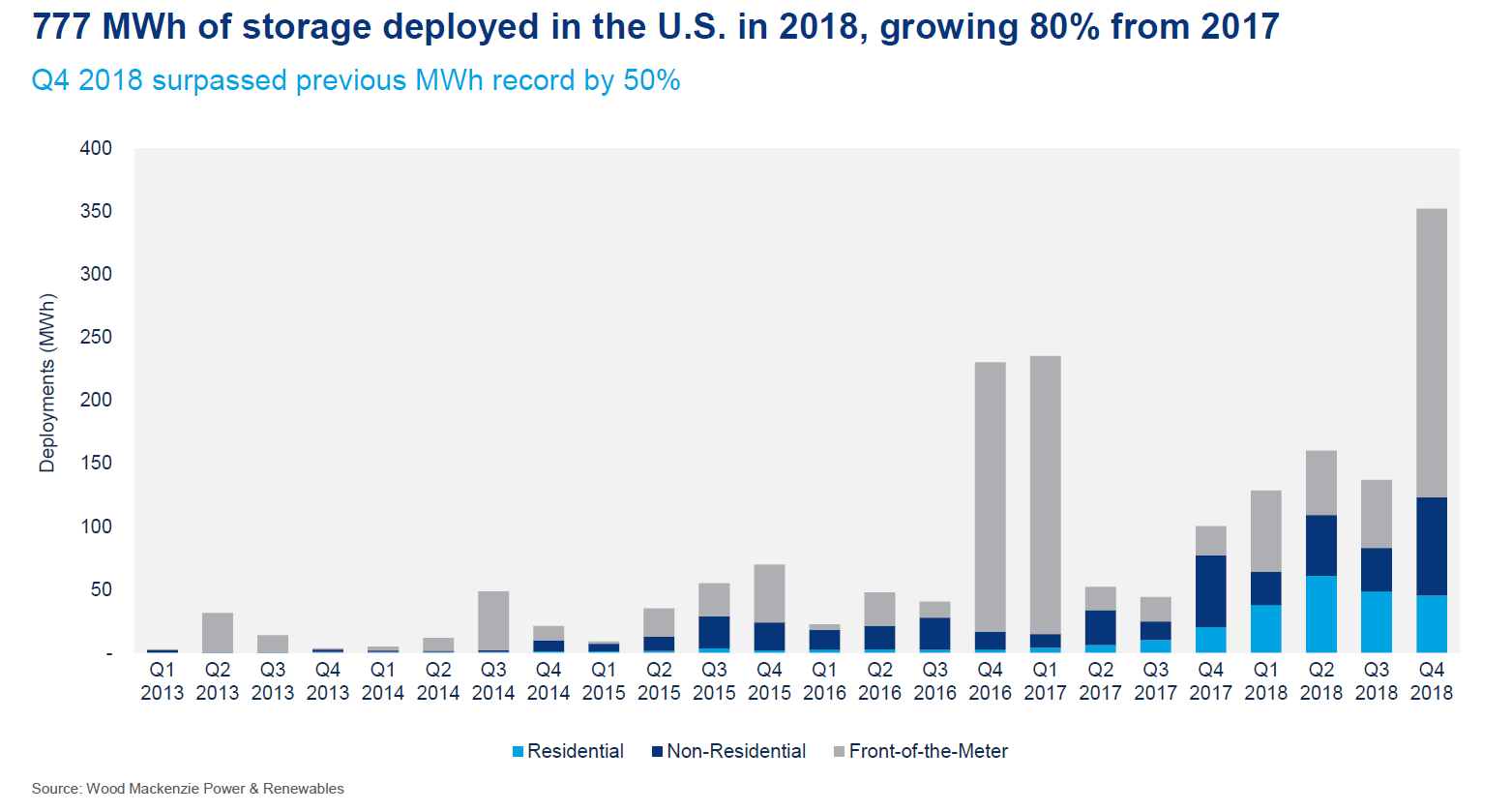
Fueled by increased interest in grid service applications like time-of-use (TOU) shifting, self-consumption and backup power, the U.S. market for energy storage doubled in 2018 and is expected to double again by the end of the year. Of the 777 MWh of energy storage deployed in the United States in 2018 (which was an 80% growth over 2017 installs), 47% came from front-of-the-meter (FTM) projects, or those built and operated by utilities. Behind-the-meter (BTM) storage systems, including residential, accounted for the other 53% of installations, and a report from Wood Mackenzie Power & Renewables and the Energy Storage Association (ESA) predicts BTM storage to account for more than half of the annual market in dollar terms by 2021 as residential storage takes off. The groups expect 2019 to close with 1,681 MWh of energy storage deployed in the United States, largely coupled with solar systems.
Credit: Wood Mackenzie
Zachary Cox, VP of operations at U.S. Battery Manufacturing, said he sees FTM projects becoming the predominant energy storage application in the future.
“I imagine a system where homes and businesses generate solar power during the day to charge utility-owned storage and then consume from that storage at night,” he said. “I still envision residential and commercial behind-the-meter storage; however, I think that the upfront costs of these systems will push utility providers to provide the storage.”
Zinc-air and lithium battery provider NantEnergy also sees growth potential in the larger installation markets.
“Until the residential systems can pay for themselves in savings they generate, it’s always going to be a niche driven by consumers who are concerned about outage protection,” said Carl Mansfield, VP of system solutions for NantEnergy. “Our vision for the U.S. is fairly widespread deployment of storage across buildings on the distribution system with many applications ranging from energy saving to critical backup to powered emergency response centers.”

Credit: EnergySage
Cost is still a determining factor for many battery purchases, and supply shortages have held back those who have the capital to invest in energy storage. EnergySage found in its latest “Solar Installer Survey” that around 56% of solar-plus-storage customers specifically request Tesla Powerwall solutions while only 12% of solar installers actually carry the products. Tesla, which has prioritized its electric vehicle production, has been notorious for product availability issues, and South Korean storage incentives led to most competing storage brands to supply product there first. Several top battery manufacturers announced new plants in an effort to increase production. As battery supply rebounds, system pricing should level out and provide more predictability to customers looking to add on storage.
Still, consumer education is key during this turning point for widespread storage adoption, said Catherine Von Burg, CEO and president of lithium-iron-phosphate battery manufacturer SimpliPhi Power.
“While I’m encouraged that storage is gaining ground, there’s more that we can do to make the public understand how it works and why it’s needed,” she said. “As an industry, we need to be better storytellers, highlighting our customers, showcasing our value and helping people understand how the energy storage solutions available today can dramatically improve their lives — from protecting their homes to reducing their energy costs.”



As the article mentions, TESLA in on the “tip of the tongue”, by 56% of those wanting behind the meter energy storage. Yet TESLA isn’t aggressively going after the home market or the home development market with their product, Biiiiiiggggg Mistake.
Now Simpliphi, LG Chem, Panasonic and Sonnen are going after the residential energy storage market. I don’t know about the other energy storage system companies, Sonnen is aggressively courting housing tract developers for an entire system, that would be installed on all of the homes in the tract. Arbitrage is just one function of these energy storage systems. The last information I could find on TESLA is they are still using Li, Ni, Co or Li, Mg, Co high density lithium ion batteries. Prone to overheat and cause fires. Simpliphi and Sonnen have adopted the less energy dense but more stable LiFePO4 battery technology. Unfortunately from testing the most stabile lithium ion technology battery is the LTO or lithium titanate battery. The energy density and voltage of this battery type is low compared to the other lithium ion battery chemistries. At 80 to 100Wh/L these LTO batteries would require a 6 foot by 6 foot by 6 foot box to hold a battery pack of about 20kWh. Sonnen is doing that same thing in 6 by 4 by 2 for 20kWh. Sonnen says their product is good for 10 years, the LTO technology depending on once or twice a day charge/discharge cycling, could be online for 25 to 50 years.