
California, the state with the most installed solar capacity in the country, has spent years trying, but still doesn’t have a community solar program. That means residential solar and storage systems are often still only accessible by the affluent, and low-income residents and renters continue to experience the country’s second-highest electricity rates without any self-generated relief.

A community solar project in Colorado, developed by Pivot Energy.
Community solar, where locally-sited solar projects are shared by multiple community subscribers who receive credits on their electricity bills for their share of power produced, offers an option for utility users to access the benefits of solar when they can’t support an installation on their own home or business. Community solar programs expand access to the renewable energy source, with special support often made for low-to-moderate income customers, while building a more distributed and resilient electric grid.
Despite the California Legislature mandating that the state create a community solar program in 2022, nothing yet has been established. Solar and community advocates have been battling with the California Public Utilities Commission (CPUC) and investor-owned utilities to establish a working community solar market, but talks have reached a stalemate. Outgoing Gov. Gavin Newsom vetoed the latest community solar legislation in September, and the state continues to lose out on this new solar market development.
Community solar history in California
In 2022, Newsom signed AB 2316 into law, which aimed to create a community renewable energy program that would support both solar and storage projects. The bill required large utilities serving more than 100,000 customers to create and implement programs that “enable ratepayers to participate directly in offsite electrical generation facilities that use eligible renewable energy resources.”
In 2024, the CPUC rejected a proposal from solar advocacy groups that would support community solar in the state, instead putting more decision-making power into local utility hands. State legislators then attempted in 2025 to pass a new bill (AB 1260) designed to strengthen and expand the initial framework for California’s community solar-plus-storage program, guaranteeing affordability to low-income customers, among other stipulations. AB 1260 was never fully adopted.
Instead, community and solar advocates threw their support behind AB 1813, the Community Renewable Energy Program Act. Groups like Californians for Local, Affordable Solar and Storage (CLASS) said AB 1813 was a workable community solar and storage program that could overcome the CPUC’s “built-to-fail” program outline.

California Gov. Gavin Newsom Photo credit: Gage Skidmore
The California Legislature passed AB 1813, which directed regulators to value community solar and storage using the CPUC’s own Avoided Cost Calculator, an existing tool the state has declined to apply, and required paired battery storage so projects deliver power when the grid needs it most. Ultimately, Newsom vetoed the bill in September, and community solar development in California is still stalled.
“With Gov. Newsom’s veto of AB 1813, California continues to fall further behind other states who are aggressively moving forward with successful community solar programs. Unfortunately, the voices of community leaders, environmental justice organizations, ratepayer advocates, labor, community choice aggregators, the building industry and so many others were denied a solution they have long fought for,” said Derek Chernow, executive director of CLASS. “Study after study demonstrates the benefits of community solar-plus-storage to households, businesses, our environment and the grid. We are committed to working with the next administration to make community solar and storage part of the solution to California’s growing affordability crisis.”
Newsom, whose gubernatorial term ends in January 2027, stated in his veto that AB 1813 “would effectively require an administratively set price for the generation of power that exceeds the value that generation provides to the grid. This would result in significant upward pressure on consumer energy bills without delivering reliable, high-performance capacity to the grid at the times we need it. Fundamentally, this bill would shift costs and work counter to the state’s energy affordability and reliability goals. For these reasons, I cannot sign this bill.”
Future of California’s community solar market
Without an approved process for bringing community renewable energy efforts online, project developers will focus on opportunities outside the state.
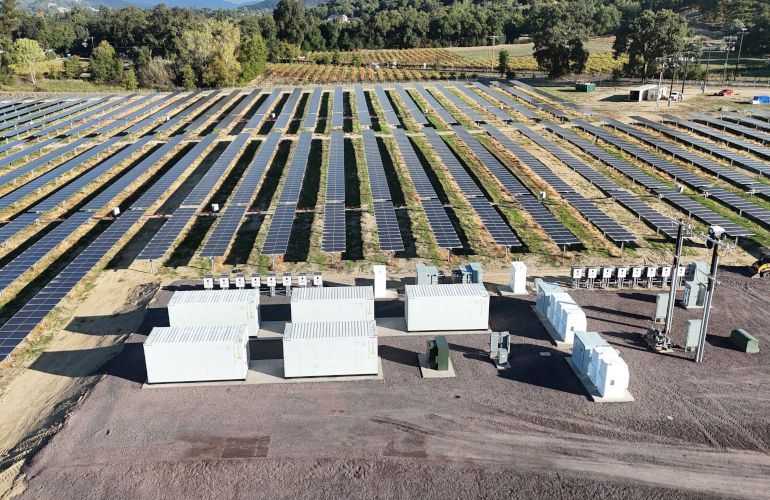
A Renewable Properties solar + storage project in California that was unable to be classified as a community solar array. Credit: Renewable Properties
Aaron Halimi, founder and CEO of Renewable Properties, a community solar developer headquartered in San Francisco, said Newsom’s veto relied on outdated cost assumptions and would hurt local rate payers looking for utility bill relief.
“Twenty-two other states have workable community solar programs that are attracting investment, creating local economic benefits and expanding consumer access to clean energy,” he said. “As a result of this veto, Renewable Properties will invest more of our resources into those 22 community solar states instead of our home state of California.”
There’s not much else advocates can do until the next legislative session begins in December. Then a new governor would have until September 2027 to sign any community solar legislation into law. Chernow said CLASS will continue putting pressure on legislators to build a successful community solar market in California.
“This unprecedented coalition of environmental justice, labor, ratepayer advocates, building industry, community choice aggregators and clean energy associations is staying strong and cohesive. We’re committed to delivering a successful community solar and storage program for Californians in 2027, through executive action and/or legislation,” he said. “Study after study shows these projects lower costs for all ratepayers, not just subscribers, and 20-plus states are already proving it. California can go from lagging to leading.”


Tell Us What You Think!