

The Dept. of Commerce today released its preliminary decision, stating that certain Chinese solar cell and panel producers in four Southeast Asian countries are indeed working in those countries to avoid paying duties on Chinese-made solar goods. Commerce has suggested an extension of antidumping/countervailing duties (AD/CVD) to solar cell and panel imports from companies working in Cambodia, Malaysia, Thailand and Vietnam.
Credit: Namaste Solar
AD/CVD have been in place against Chinese solar imports since 2012. Commerce should release its final determination on May 1, 2023.
The tariffs are against crystalline silicon cells produced in the four countries from wafers produced in China and final panels made with wafers produced in China that also use three of the following Chinese-made materials: silver paste, aluminum frames, glass, backsheets, ethylene vinyl acetate sheets and junction boxes. Wafers produced outside of China with polysilicon sourced from China are not considered to be wafers produced in China and are not included in this scope.
Today’s preliminary decision from the Dept. of Commerce extends the tariffs to all companies working in the four countries unless explicitly stated otherwise.
- Companies that either did not respond to DOC requests for information or were investigated and found to be circumventing the Chinese tariff orders by working in Malaysia: AMC Cincaria, Flextronic Shah Alam, Funing Precision Component, Samsung, Vina Solar Technology.
- Companies circumventing the Chinese tariff orders by working in Thailand: Trina Solar, Canadian Solar, Celestica, Green Solar Thailand, Lightup Creation, Thai Master Frame, Three Arrows, Yuan Feng New Energy, Solar PPM, Sunshine Electrical Energy.
- Companies circumventing the Chinese tariff orders by working in Vietnam: Vina Solar (LONGi), Global Energy, GCL, Green Wing Solar Technology, HT Solar, Irex Energy, S-Solar, Venergy, Sunergy, Red Sun Energy.
- Companies circumventing the Chinese tariff orders by working in Cambodia: BYD.
- Companies explicitly stated within Commerce documents to NOT be circumventing the Chinese tariff orders by working in Southeast Asia and therefore EXEMPT from any additional tariffs: New East Solar (Cambodia), Hanwha Qcells (Malaysia), JinkoSolar (Malaysia) and Boviet Solar (Vietnam).
This investigation has hung over the U.S. solar industry for two years. A group of anonymous solar panel manufacturers first asked Commerce to take a look in 2021 at specific Chinese solar panel manufacturers working in Southeast Asia as a way to circumvent AD/CVD requirements. Commerce rejected that petition because of the anonymous nature of the petitioners. California-based solar panel assembler Auxin Solar then put its name on a new petition in 2022 and became the main voice behind the request. Auxin officials claim that Chinese solar producers working in Southeast Asia are unfairly pricing their products to undercut American manufacturers.
Credit: S&P Global
Once the investigation began, module supply from Southeast Asia — a region that supplied 80% of U.S. demand in previous years — became limited. Many manufacturers were waiting to see DOC’s decision before shipping panels (that may have retroactive duties) to the United States. This uncertainty — along with global supply chain issues — led President Joe Biden to announce a two-year pause on any additional tariffs in June 2022. The Biden Administration postponed any tariff initiation to “ensure the U.S. has access to a sufficient supply of solar modules to meet electricity generation needs while domestic manufacturing scales up.” Today’s tariff decision (with its May 2023 final determination deadline) will not go into effect until after June 6, 2024 due to Biden’s executive action.
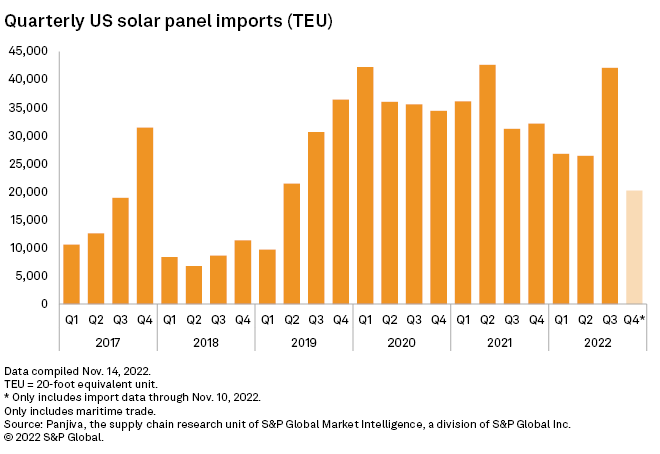
S&P Global analyzed U.S. solar panel imports since Biden’s two-year tariff waiver and found a dramatic spike in imported solar panels in Q3 2022. The number of shipping containers carrying solar panels to U.S. ports jumped 59% from Q2.
Credit: S&P Global
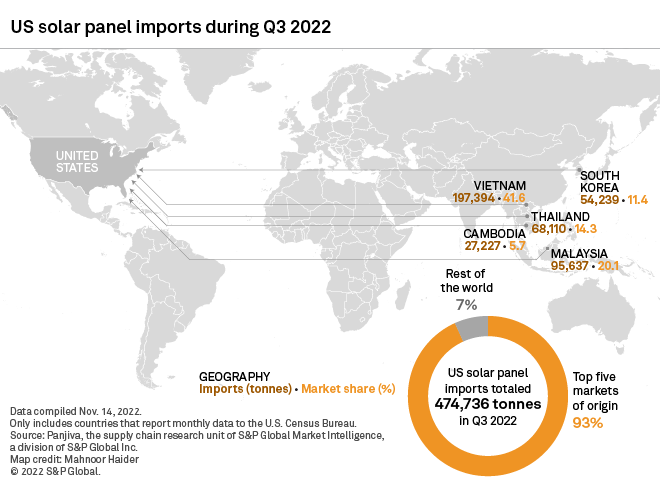
The group found that 82% of solar panels imported in Q3 2022 came from the four Southeast Asian countries at the center of this case. Vietnam accounted for 41.6%, Malaysia was 20.1%, Thailand was 14.3% and Cambodia was 5.7%. Chinese imports accounted for only 0.1% of the U.S. supply during the same period. U.S. module buyers are fully taking advantage of Biden’s pause on tariffs.
While there have been more announcements for new U.S. solar cell and panel manufacturing outfits since the inclusion of tax credits in the Inflation Reduction Act this past summer, the country’s demand far outpaces supply, and solar panels will continue to be imported. These new tariffs will touch all markets — residential through utility-scale — beginning in 2024 and beyond.
George Hershman, CEO of SOLV Energy, the nation’s largest utility-scale solar installer, said that today’s decision could jeopardize the solar industry’s ability to build projects to meet climate goals.
“I am a longtime advocate of the Inflation Reduction Act’s tax credits to incentivize domestic panel production that will support future solar deployment and help us regain our position as a global leader in renewable manufacturing. However, it’s inherently hypocritical to call the same manufacturing process taking place in the targeted countries ‘minor and insignificant’ when we’re incentivizing the exact same process here in the U.S. It doesn’t pass the commonsense test,” he said. “Ultimately, we need to put an end to harmful trade barriers and instead focus on creating jobs and bolstering our energy independence.”
Today’s specific company outline is good news for South Korea’s Hanwha Group. Hanwha’s large solar cell and panel manufacturing outfit in Malaysia will be able to assist in the company’s U.S. manufacturing expansion efforts without extra tariffs. Maxeon, a Singaporean company that makes solar cells in Malaysia, is also planning U.S. manufacturing that would depend on Malaysian product during ramp-up. While not mentioned in either the tariffed or nontariffed camp today, Maxeon officials had previously told Solar Power World that the company would try for a tariff exclusion due to Maxeon’s “premium pricing” that could not be interpreted as dumping. We are not aware of what wafers Maxeon uses in its products.
Abigail Ross Hopper, president and CEO of the Solar Energy Industries Association (SEIA), released a statement. SEIA has actively been campaigning against tariffs being extended to the four countries.
The only good news here is that Commerce didn’t target all imports from the subject countries. Nonetheless, this decision will strand billions of dollars’ worth of American clean energy investments and result in the significant loss of good-paying, American, clean energy jobs. While President Biden was wise to provide a two-year window before the tariff implementation, that window is quickly closing, and two years is simply not enough time to establish manufacturing supply chains that will meet U.S. solar demand.
This is a mistake we will have to deal with for the next several years.
American Council on Renewable Energy (ACORE) president and CEO Gregory Wetsone released the following statement:
The good news is that we look forward to the development of an enhanced domestic solar manufacturing base over the next few years, spurred in part by the incentives in the Inflation Reduction Act. But that will not happen overnight. Like most sectors of the American economy, the solar industry has a global supply chain and a business model that relies on stable policies and predictable pricing. Today’s decision will limit our ability to fortify our supply chain and reflects the dramatic shift from ‘free trade’ policies to protectionism in both parties. American consumers, and the effort to protect our climate, are unfortunately caught in the middle.
Michael Parr of the Ultra Low-Carbon Solar Alliance, which is promoting solar manufacturing within the United States, provided a statement:
Statement from American Clean Power Association (ACP) interim CEO and chief advocacy officer JC Sandberg:
“American solar companies are making critical 2024 procurement decisions now and today’s decision casts greater uncertainty about the future of the solar industry in the U.S. that could lead to higher electricity bills. It could also undermine the impact of the Inflation Reduction Act, harming domestic manufacturing and endangering good-paying jobs across the country.




Thank you for the depth of this article:
” Wafers produced outside of China with polysilicon sourced from China are not considered to be wafers produced in China and are not included in this scope.”
The geopolitical leverage is still in place. So far, China still has the bulk of silicon foundries in the World and (right now) this political unrest and China’s party proper regional shutdown/isolation of manufacturing centers is still affecting the supply chain of poly silicon around the World. When one affects the supply chain, it constricts projects sitting in queues, keeps installers and support groups out of work and has a ‘destructive’ effect in employment and construction in the alternative energy field around the World. (IF) the IRA does spark manufacturing of supply chain materials in the U.S. for solar PV factories in the U.S., it will be at (least) a couple of years before the infrastructure is constructed and online supplying American Made poly silicon and solar cell services for solar PV crystalline cell panel manufacturers in the U.S.. H.R. 1155 the Unghyrs forced labor act also plays a part in the amount of poly silicon one can get from China as China has poly silicon foundries in this region also.
I’ve said it before, the only (real) solar PV panel manufacturer in the U.S. that has had success for 22 years is First Solar. Of all these ‘other’ solar PV panel manufacturers in the U.S. even the company Auxin that filed this AD/CVD complaint are not low carbon manufacturers of solar PV panels, are still in the ‘carbon rich’ manufacturing line. First Solar has at least three less steps for their panels, do not require poly silicon and a foundry to create the pulls, cut into wafers and doped into cells to assemble into solar PV panels. First Solar has had a cradle to cradle recycling plan in place since 2003, First Solar has announced the company will power their manufacturing lines using solar PV derived energy in all of its plants World wide by 2028. Now First Solar needs to review their manufacturing line panel sizes. First Solar could produce a 20 (68 inches x 42 inches) square foot CdTe panel of around 340 watts output, this would be a great addition to the retail residential solar PV industry.