

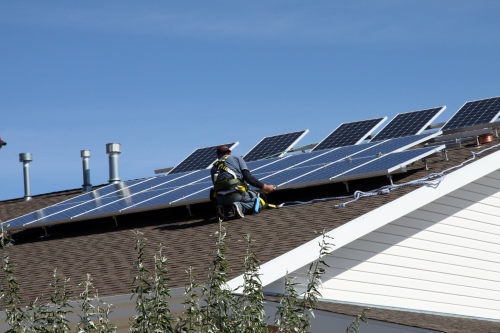
The Arizona Public Service Company installed 4 kW of residential photovoltaic on household rooftops for the Community Power Project in Flagstaff, Ariz. This was part of a project to study the effects of large amounts of distributed PV on a utility feeder. -Photo courtesy of Arizona Public Service Company
2013 was a year of evolution for the solar industry in Arizona. Chief among industry-changing events was the acrimonious debate over net metering, as the utilities tried to stifle a burgeoning rooftop solar movement. In a white paper, utilities portrayed rooftop solar as a threat to its century-old business model.
The utility industry employed hard-core political campaign tactics in their quest to control the solar marketplace, even running TV ads that accused solar customers of freeloading off traditionally powered neighbors. The utilities say residential solar producers don’t pay a fair share of the cost of maintaining transmission lines that carry the excess power they produce back to the grid and to their neighbors.
The debate generated copious media coverage, but solar advocates were able to soften the potential damage. The utilities had sought steep fees on residential solar producers that would have severely damaged the future of solar adoption in the state.
The utilities ended up with a hollow victory. The Arizona Corporation Commission voted to impose a small fee on new residential solar electric installations. But even the small monthly fee imposed on new residential rooftop solar sets a precedent, and other states, including neighbors in Utah and Colorado, are now grappling with the net-metering question.
It’s too soon to tell how this fee will affect Arizona solar installations, which, before the onslaught of utility attack ads, averaged more than 500 per month. A year-end rush to beat the new fee will likely result in fewer installations in at least the first quarter of 2014.
The utility pushback may be affecting Arizona’s solar industry in other ways, too. News accounts tell of a subtle rift between Arizona installation companies and solar-leasing companies. The solar water heating industry, meanwhile, has dissociated itself from the solar electric industry by marketing itself as “the other rooftop solar technology.” (Solar water heaters use sunlight to heat water, so they conserve energy rather than produce electricity.)
It’s a warped Good Solar vs. Bad Solar struggle, and nowhere is it more obvious than in the investor-owned utilities’ embrace of utility-scale solar and their efforts to slow down rooftop solar. The utility-scale solar projects fit the existing utility business model: central plants generating power distributed to customers through traditional transmission lines.
But those who wish to write a premature obituary for solar in Arizona should remember that the state has been on the vanguard of solar technology, policy and use since Abe Lincoln was president.
It began in the 1860s when the heliograph became the first in a series of solar technologies to be introduced and tested in Arizona. It progressed from there to the Day-Night Solar Water Heaters of the 1930s, the 1954 introduction of silicon solar cells and their off-grid applications of the 70s and 80s. The late 90s brought utility-scale photovoltaic plants.
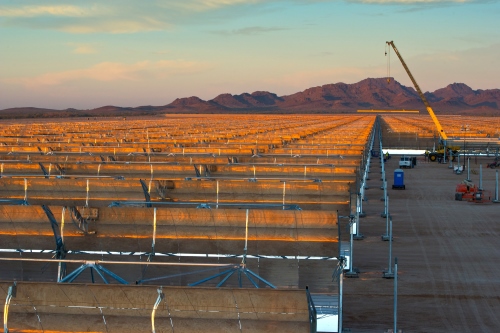
Crews worked around the clock in 2012 installing mirrored parabolic trough collectors, built on site, which will cover three square miles at Abengoa’s Solana Plant. Solana is a 280-MW utility-scale solar power plant under construction in Gila Bend, Ariz. When finished it will provide electricity for more than 70,000 Arizona homes. -Photo courtesy of Dennis Schroeder / NREL
The success of these technologies belongs uniquely to Arizona. Nowhere is Arizona’s role more elegantly stated than in the writings of the late John Yellot, an Arizona State University professor, inventor and pioneer in passive solar energy. In 1978, Yellot, affectionately known as the Ambassador of the Sun, wrote that solar technology “belongs to Arizona in a special way – as a part of the great American frontier where new devices are ever welcomed and their merits tested and proven and achievements acclaimed.”
The biggest test for the Arizona solar industry will be whether it can reunite rather than fragment in the face of well-financed attempts to darken its future. If the solar industry can heal the developing fissures, Arizona can emerge from 2014 with its reputation as the solar state intact. Arizona can survive and prosper as the place where new solar devices and policies are tested and proven –— “and achievements proclaimed.”
By Jim Arwood, communications director of the Arizona Solar Center. The Arizona Solar Center, founded in 1998, is a non-profit, non-partisan organization whose mission is to promote the use and utilization of solar energy. The Solar Center maintains an informational website, conducts workshops and solar tours and performs third-party solar water heating quality-control audits as part of the utility rebate process.

Tell Us What You Think!