
Steel is considered the backbone of the American economy, critical for both national and economic security. It’s also the backbone of solar power construction, found commonly in the racking and mounting structures tilting solar panels toward the sun. And now, after years of tests and trials, an Ohio factory is roll-forming steel for a solar product that could use a stronger backbone — the solar panel.
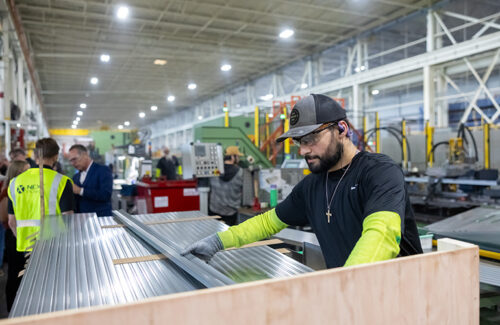
A factory worker places a section of steel solar panel frames on a pallet in Welser Profile’s plant in Valley City, Ohio. Credit: Nextpower
Roll-form steel company Welser Profile began manufacturing Nextpower’s NX CoreFrame steel panel frames earlier this year at its facility in Valley City, Ohio, just 30 miles outside Cleveland, and Solar Power World was invited to view production of its first major orders before adding another line fully dedicated to the solar component before the end of the year. Module frame company Origami Solar originally had the idea that swapping aluminum frames with steel would not only save the solar industry money and cut back on carbon emissions, it would also provide more physical support to bigger and heavier solar panels.
Welser, an Austrian company with origins dating back to the 1660s, is a leader in roll-form steel profiles typically only seen in aluminum extrusions and helped produce a steel frame that’s easy for panel manufacturers to assemble and contractors to handle.
“What’s special about Welser Profile is we pre-notch features in the material before it gets formed,” said Bill Johnson, North America CEO of Welser Profile. “Everything about the solar industry is about how do we make it more efficient, cheaper, faster, better? You do that by all these little details to add value farther up the stream that minimizes labor, install cost. Our hole patterns and other features allow operators to snap things together, not bolt or weld things. Everyone is looking at how to make this work in a Lego setup, not a high-intense labor workforce installing all these panels.”
Welser is helping bring the Origami Solar idea to life, but the new owner of the tech, Nextpower, is delivering steel frames to the masses. Nextpower, a steel expert through its experience in producing tracking and mounting systems, acquired Origami in 2025 and will use its existing network of steel partners to convince more PV project developers to consider an alternative to aluminum.
“Nextpower has launched over 30 manufacturing facilities in the U.S. since 2020. Nextpower buys over 700,000 short tons of primary U.S. steel annually, which is more than a small car company,” said Jenya Meydbray, VP and general manager of Nextpower’s steel frames business. “Nextpower has had [the steel frame] for one year, building on the years of Origami’s engineering with Welser’s support. What we’re doing today is launching into high-scale, high-volume production here in Ohio.”
Why switch from aluminum to steel?
The solar industry defaulted to aluminum panel frames because the material is lightweight, easy to handle and less susceptible to corrosion. But as the solar industry matured, more environmental and practical issues became associated with the metal. Aluminum production on average has a five-times larger carbon footprint than steel production, a difficult point to ignore in the inherently green solar industry. Solar panels have also gotten larger in surface area and use less glass to cut weight. Aluminum might no longer be the ideal material to physically support these “big, floppy modules.”
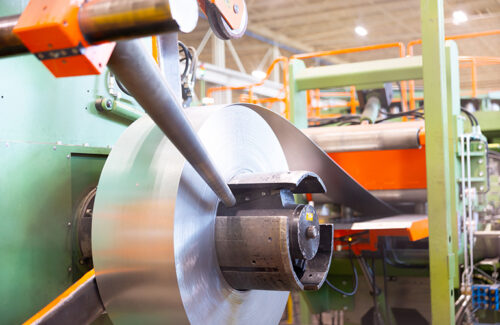
A steel coil feeds into a roll-forming machine producing solar panel frames. Credit: Nextpower
“Steel provides a far better structural support for the [panel] than aluminum does. That was the initial observation that the Origami founders made,” Meydbray said. “They landed on this specific [roll-form] profile. Roll-forming is a precision process. We’re making millions of sticks of solar panel frames a month, and all of them have to be within sub-millimeter of precision across the full length. Welser is 100 years older than America, so Welser is definitely the most experienced in this art form of steel roll-forming.”
Welser set up North American operations in 2018 after acquiring an automotive roll-form operation in Valley City. The company established a second location in the same industrial park to accommodate its growing client base in the solar, storage and energy industries.
Welser was one of the first roll-form partners to validate Magnelis — a zinc magnesium coating that has “self-healing” properties is capable of lasting 25 years in the field — and found it a great steel coating for solar energy applications. It’s one of the features of NX CoreFrame, Nextpower’s steel solar module frame.
“Coming up with a new coating on steel, you don’t just throw it on the steel and sell it to the market. You have to trial it, validate it, make sure it works,” Johnson said. “Raw zinc — the coating has to be too thick for the longevity that the solar industry needs. Magnelis can go much lighter coating and still produce the same salt spray, same longevity, and it’s cheaper, faster, smarter.”
Wesler is the latest high-volume production facility for NX CoreFrame, and Nextpower plans to reach 6.5 GW of annual production through additional manufacturing partners across the country.
Convincing the solar industry
With an established steel frame design, the product just needs to find a place on panel manufacturer’s production lines. Origami Solar had been signing supply agreements with U.S. panel assemblers, an activity that has only increased with the Nextpower transition. Meydbray said the pitch for a domestic supply chain has become more attractive, especially with Nextpower’s established regional steel manufacturing network.
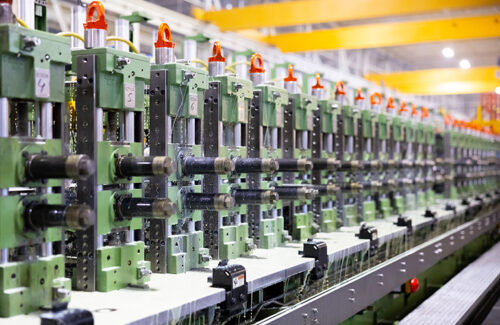
A machine treats steel coil as it travels along a factory line. Credit: Nextpower
“Steel strengthens the supply chain of domestic manufacturing facilities. When frames are bought overseas, they spend five, six weeks on the water before they actually arrive to the factory. [Panel companies] have about 2,000 pallets of frames in inventory when they source from overseas,” he said. “We’re able to provide actual just-in-time delivery to our factory clients. We can make deliveries every 48 hours. [They can save room] where they used to have pallets stacked up. There’s also the working capital of having stuff sit on the water for six weeks. Solar panel manufacturing is not a high-margin business, and working capital management is critical.”
Nextpower has inked supply agreements with many multi-gigawatt panel manufacturers in the United States, including Jinko, T1 and Thornova.
“This integration of Nextpower steel frames allows us to deliver high-performance modules tailored to the evolving U.S. market,” said Andrea Bodenhagen, global marketing director at Thornova Solar, which is establishing domestic solar cell manufacturing in Oklahoma. “By incorporating U.S.-made steel frames, we strengthen supply chain resilience while helping our customers maximize domestic content and improve project economics.”
With bonus incentives from the investment tax credit still in play when solar projects use domestic products, an American-made steel frame can make all the difference.
“When we see projects that have 100% domestic content on the tracker, we know that’s a perfect candidate for steel frames,” Meydbray said. “Steel frames get 6% domestic content credit. It’s the second cheapest percent after the tracker. A domestically made solar cell is a lot more expensive than an imported solar cell. The frame is the second-most cost-effective way to buy percentage points.”
The NX CoreFrame is universal and can be used with any brand’s mounting or tracking system, but there are advantages when the project can be designed more cohesively through one supplier. Nextpower has spent the last year expanding beyond mounting systems, now offering inverter, electrical balance of system and panel products.
“[Nextpower] is ambitious, but it’s not arrogant. It prioritizes the customer relationships it’s built over the years. We spent time with our customers asking where their pain points are and expanded the business accordingly … the company that makes the thing the solar panel is mounted to is the same company that makes the frame that’s being mounted,” Meydbray said.

Tell Us What You Think!