
A building that started as a one-room schoolhouse has through the decades expanded to become a lifeline for a New Mexico community far from any city infrastructure, and a recent solar installation has brought new resilience to this place.
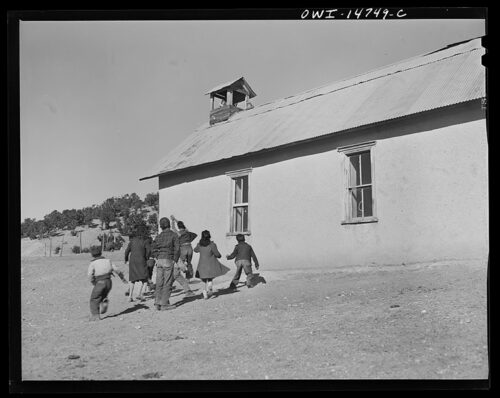
Children run outside of Ojo Sarco, New Mexico’s one-room schoolhouse in a photo from January 1943. The structure still stands today as the Ojo Sarco Community Center. Credit: John Collier, Jr./Library of Congress
The structure housing the Ojo Sarco Community Center (OSCC) was founded in the early 20th century. Ojo Sarco is an unincorporated community home to about 300 people that is located about 43 miles northeast from Santa Fe.
“We have no political voice, really,” said Carol Miller, a grant writer and board member for the Ojo Sarco Community Center. “We’re pretty neglected. We’ve lost resources in the past. We were the first wave of people to lose our post office many years ago. Everybody has to commute pretty much for everything.”
That commute is about 40 minutes round trip for basic amenities, she said.
The community center has tried to fill in those resource gaps with services like a twice-monthly food bank, summer meal programs for kids, safety classes and outings for its residents, such as a night at the opera. The OSCC also recently met all the qualifications to be a state library.
PPC Solar, also known as Paradise Power Company, from Taos, built a 7.5-kW solar project paired with 10.6-kWh of LFP energy storage at the OSCC. The contractor built the array at no-cost to the community center. Every year PPC donates a solar array to a regional nonprofit organization, and after three years of applying, the OSCC was awarded the project.
CEO Daniel Weinman’s father founded Paradise Power Company in the 1970s, and the company has installed solar in off-the-grid communities since the start. Its PV donation program is built out of that tradition.
“We’ve always wanted to find a way to give back to the community,” Weinman said. “The best thing that we found — and we’ve been doing it for over a decade now — is doing an annual nonprofit donation system … We’ve had farming organizations, land conservation organizations, and it goes on and on. Really, it’s about finding the right fit. We wanted to make a good impact for this community center, and we felt resiliency was the best way to do that.”
Solar Power World spoke to both PPC Solar and organizers with the OSCC about what effect this solar project has had in the village since it was built in fall 2025.
SPW: What has this solar project made possible for Ojo Sarco Community Center?
Larry Miller, project manager and OSCC board member: I think it’s a transformative project for our small community. We like to talk about the history of the community center, and now this is part of it. If someone doesn’t notice the solar panels on the roof, we point it out to them. It’s integrated into our lives here.
Carol Miller: It’s lowered our electric costs, which is really important for us, because we’re such a shoe-string operation. We’ve had some fun talks with the community because they all know we’ll have the charging capacity. We still have internet available, even with the power out. All the kids that come to our library programs, they’re solar oriented. The benefit of this company and its staff just has ripple effects throughout our greater community.
So, it’s been about a year since the project was completed. Looking back, were there any challenges in terms of construction or permitting that you encountered?
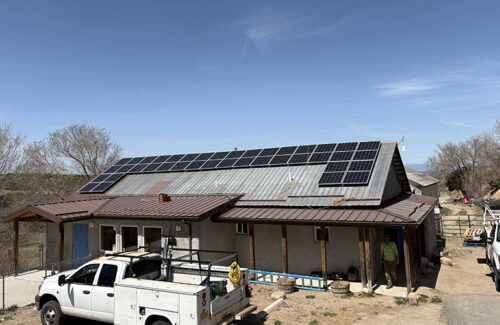
PPC Solar donated a solar plus storage project to the Ojo Sarco Community Center. This array will keep power running in this facility that has become a haven for Ojo Sarco residents. Credit: PPC Solar
Preston Bastardo, sales and design, PPC Solar: The building itself had some challenges with mounting the array on the roof, but that just took some exploration in the attic and making sure that we could land things where we needed to. The building has two large areas, and so fo installation of batteries had some restrictions, there was a good mechanical closet that we were able to use for batteries. Then as far as backup circuits, we did a partial facility backup where we had a critical loads panel next to their main panel. I think everything went pretty smoothly.
Dan, how does it feel continuing this legacy of building solar projects in communities like Ojo Sarco so many years after the company was founded?
Weinman: Well, it really goes back to our roots. In 1972, there was no technology supporting solar at the time. My dad was a pioneer in the industry and he really developed his own controls and safety protections and found used panels and used batteries and was bringing power to places where there was no power. Our house, for example, we started with kerosene lanterns. We didn’t have electricity until we had a solar power system, and it was really life changing.
Being able to build on that legacy and look at our community in that light and be able to offer systems like this to communities that need it — I think that really adds to that legacy and really is profound in a lot of ways. It feels great to be able to do this and be in a position where we can help others realize and experience the benefits of solar power. We want to continue to participate in any way we can.
Does anybody have any closing thoughts about this solar project at the OSCC?
Carol Miller: We’re a very old community and proud of it. And having worked with local businesses and our electrical co-op, we know it’s really the exception and not the rule because we own our power. Any technology that is shared equally in a low-income community has ripple effects beyond what I think some of us imagined a number of years ago. It’s for everyone.



Tell Us What You Think!