
Every solar asset manager knows the math. Dust, pollen, bird droppings, agricultural residue and salt film can steadily eat into production, and depending on climate and tilt, an uncleaned array can lose a meaningful share of its expected annual yield. The cleaning decision has always been a trade-off: production losses on one side, and the cost and risk of putting crews, water trucks and equipment onto rooftops, carports and ground-mount sites on the other.
A new option is changing that calculus: the cleaning drone.
What is drone cleaning?
 A cleaning drone is a heavy-lift unmanned aircraft system (UAS) fitted with a hose-fed spray system capable of everything from low-pressure rinsing and soft washing to pressure washing at several thousand PSI. The pilot stays on the ground. The aircraft delivers water, deionized rinse (if necessary) and cleaning solution from above, covering surfaces that would otherwise require rooftop crews, lifts or scaffolding.
The technology earned its reputation cleaning structures people couldn’t safely reach, such as high-rise glass, storage tanks and stadiums. Solar arrays are a natural next application.
Why it matters for solar
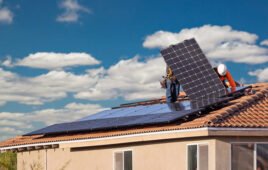
Safety first. Rooftop commercial solar is exactly the environment EHS managers worry about: height, slope and a surface one shouldn’t walk on. A drone takes the crew off the roof entirely. No harnesses, no anchor points, no lift rentals, no fall exposure. For carport canopies and elevated structures, the advantage is even more pronounced. OSHA reports 37% of construction fatalities are due to fatal falls. A drone reduces that fall risk.
Speed and uptime. Because there’s no access equipment to set up, drone cleaning compresses job timelines dramatically. Faster cleaning means shorter O&M site visits, less disruption and quicker recovery of soiling losses.
Panel-friendly contact-free cleaning. Drones clean without anyone walking on arrays or dragging equipment across modules, reducing the risk of microcracking and damage claims that come with foot traffic and brush rigs.
Hard-to-reach sites become routine. Steep rooftops, arrays bordered by water and tightly packed carport rows are precisely the jobs that price highest with traditional methods, and where drones offer the largest savings.
How solar contractors can get involved
 The barrier to entry is manageable: In the United States, all one needs is an FAA Part 107 Remote Pilot Certificate, a purpose-built aircraft, training and commercial insurance. Basically, it’s a business in a box for $75,000.
A camera drone with a sprayer bolted on won’t survive this work. The recoil from water exiting a nozzle at thousands of PSI demands an airframe and flight controller engineered for it. When evaluating drone platforms, the criteria that matter most include:
Reach. Maximum working height determines which rooftops and structures can be serviced.
Airframe weight. Lighter is better: the FAA caps small UAS at 55 lb/25 kg including payload, so a lighter airframe pulls more hose and water higher before hitting the regulatory ceiling.
Autonomy. Hands-free cleaning modes matter enormously on solar, where the work is repetitive, row-by-row coverage. Automated cleaning improves consistency across thousands of identical modules and lowers the pilot skill barrier.
NDAA compliance and origin. Federal-property and government work requires NDAA-compliant aircraft, and the FCC’s late-2025 move to block new foreign-made drones (with exemptions expiring at the end of 2026) makes American-made platforms the future-proof choice for U.S. operators.
Training and support. Ask what’s included, how many operators it covers and whether the manufacturer answers the phone.
Here’s how the major cleaning drone platforms compare:

Information from Apellix
Once a UAS is chosen, solar contractors should take training seriously, set up a drone business with adequate liability insurance and then find customers. Drone cleaning is typically priced per square foot, per job or as a day rate, with premiums for access-constrained sites — panels backing onto water, steep terrain or anything a lift can’t reach.
The bottom line
Soiling losses are predictable, recurring and expensive, which makes panel cleaning one of the most defensible line items in any O&M budget. Drone cleaning attacks the cost-side of that equation: faster jobs, no rooftop crews, no foot traffic and access to sites that were previously impractical to clean at all. For solar contractors looking to differentiate, and for asset managers writing next year’s O&M scope, it’s a technology worth a hard look in 2026.
Apellix is an aerial robotics company that develops semi-autonomous drone systems to safely perform high-risk tasks such as power and soft washing. Apellix drones are engineered and manufactured in the United States, and the company proudly employs U.S. veterans.
I wonder if a tethered drone would need to be closely regulated.
It should also be much cheaper than trying to get enough fly time with heavy/expensive batteries.
Maybe not applicable for high-rise buildings, it might be great for residential solar panels which are not very high off the ground.
I could see a power cord and even a small hose (3/8″ poly) to supply water.
The cleaning drone could be navigated with a ground based joystick controller, and have some automatic features that recognized a solar panel, soaped it, and then blasted it.
I’d hire a service to clean my panels yearly if it was affordable — Say $50 + $2/panel .