
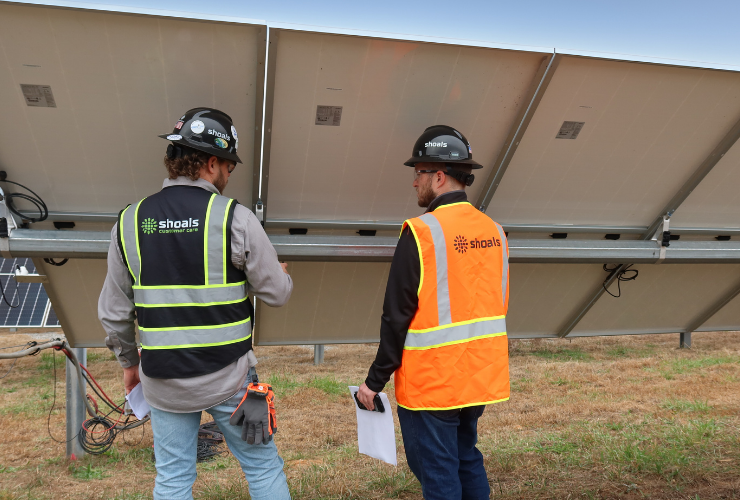
A real-world time study shows the differences between installing a factory-fabricated trunk bus solution vs. insulation piercing connectors. One of which reduces labor, risk, and schedule delays for utility-scale solar.
By Nick Bramel – Product Line Manager, Shoals
Utility-scale solar is under more pressure than ever. AI-driven data center growth is straining the grid, IRA incentives are winding down, and developers are expected to build faster, leaner, and with fewer skilled electricians. Labor shortages, tight schedules, and swelling interconnection queues mean the industry is scrutinizing every part of the build process to recover time.
In conversations with engineering, procurement and construction (EPC) partners and solar project developers, one request keeps coming up: obtain real, measurable data that shows where efficiencies are gained.
To answer the call, Shoals conducted a controlled installation time study to capture real world data on comparative differences between our patented Big Lead Assembly (BLA) trunk bus and traditional insulation piercing connectors (IPCs).
BLA vs IPC Time Study: Structure and Setup
We approached an experienced regional EPC known for completing more than 1,400 solar projects across the Southeast to help us conduct this study. They weren’t Shoals installers. They weren’t IPC or BLA specialists.
We set up a demo section — 18 strings with IPCs and 18 with Shoals BLA — with conditions each string would normally face, and watched the crew get to work.
- Demo size: 18-string installation
- Crew: Small, mixed-experience team with equal familiarity with BLA and IPCs
- Conditions: Identical terrain and environment
- Mounting: Same racking layout and string lengths
The goal was simple: measure installation time in a way that mirrors real-world IPC and BLA work. We wanted apples to apples: same hands, same tools, same environment. Though there were varying components for East-West and North-South configurations, the general installation procedures were as follows:
IPC
- Roll out the trunk/string wire
- Measure and cut trunk and drop wires to length
- Field install connectors onto drop/string wires
- Install the IPCs on the trunk with drop wires (E-W)
- Hang the trunk along the messenger wire/cable management system
- Make the connection between string wires and IPC drop wires (N-S)
BLA
- Roll out the prefabricated BLA trunks/string wire
- Hang the BLA along the messenger wire/cable management system
- Make the connection between the string wire and BLA pigtails (N-S)
- Hang the BLA along the messenger wire system (E-W)
Observations: Two dramatically different processes
IPC preparation & installation challenges
- Each pigtail must be sized, stripped, and landed manually in the field, introducing major risk for human error and inconsistent quality.
- IPC locations must be determined on site by interpreting drawings, adding placement inconsistencies and more opportunities for mistakes.
- The IPC housing must be split open, exposing sealing gel to dirt, dust, debris, and insects—common in real solar environments.
- Gel transfers to the installer’s hands, creating a slippery and unsafe grip environment.
- Reassembling the IPC housing requires precise alignment that is much harder in the field than on paper.
- Even when complete, the IPC appears “unfinished” and visually vulnerable, increasing concern about long-term durability.
Some parts of this process surprised the crew. And as they worked, we saw something you can’t capture in a spec sheet: the stop-and-go rhythm, the interruptions, the alignment checks, the second set of hands needed almost every time. One of the installers shook his head halfway through: “Every connector is basically its own mini job.”
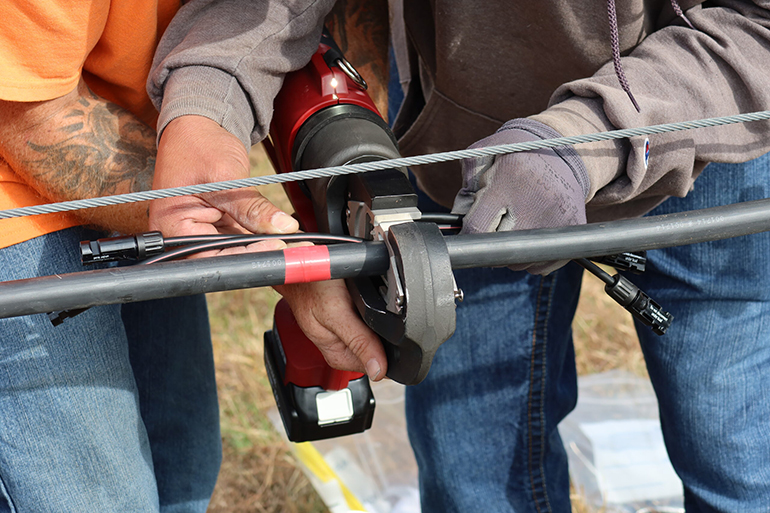
It takes two people and a lot of effort to install an IPC.
BLA preparation & installation
With Shoals BLA, everything was pre-engineered. Everything fit. No surprises. Each one of these steps carries risk. BLA eliminates all of them. Factory-terminated harnesses mean:
- No stripping
- No cutting
- No exposed gel
- No special tools
- No alignment checks
- No multi-step sealing requirements
The results: BLA installed upwards of 40% faster
The difference was immediate and consistent. BLA installed up to 40% faster. And here’s what shocked the installers most: the IPC strings didn’t just take longer, but they took different amounts of time every single time. BLA, on the other hand, delivered the same result again and again.
- IPCs introduced a lot more touchpoints, increasing labor hours and error risk.
- BLA installed upwards of 40% faster across the 18 strings.
- IPC workflow time varied significantly.
- BLA time remained stable due to its standardized, factory-built design.
Implications for EPCs and Developers using BLA:
- Reduction in labor hours
Fewer terminations mean fewer electricians resulting in fewer bottlenecks on critical paths. - Compressed schedules
Predictable string times help planners forecast daily output and hit milestones. - Lower rework
IPCs require follow-up quality checks that are nearly impossible to perform in the field, leaving them a black box with failure risks that may only surface later. - More efficient crew utilization
Installers can stay productive even in dust, heat, wind, and rain. They can avoid downtime from weather or complex tool setups and deploy smaller crews. - Risk reduction
BLA removes all field variability by delivering a sealed, factory-quality termination every time, and tested for 35+ year service life. In large-scale solar, this is fundamental to long-term asset performance.
When every minute counts, BLA delivers where IPCs can’t
The Shoals BLA vs IPCs time study didn’t just validate BLA’s installation performance. It told a real, human story about how work actually gets done in the field. The study confirmed that BLA is faster, easier, safer, more consistent, and far more predictable than IPCs.
Want to learn more about Shoals’ Big Lead Assembly? Explore the BLA product line.
Sponsored Content by Shoals Technologies Group

I’m curious to know what the difference in material costs are and how that compares to the labor savings? I presume Shoals BLA is more expensive to procure, but agree is saves labor costs. This study is only telling half the story.