Solar Power World

  • Home
  • Top Solar Contractors
  • Articles
    • Most Recent Posts
    • News
      • Latest News Items
      • SPW State News Hub
      • IRA/OBBBA coverage
      • Solar tariffs
      • U.S. manufacturing updates
    • Featured
      • Latest Feature Stories
      • Benchmarking U.S. Solar Manufacturing
      • SPW’s Rising Stars
      • Trends in Solar
      • The Solar Explorer
  • Policy
    • Latest policy headlines
    • IRA/OBBBA Coverage
    • Tariffs and Court Cases
  • Markets
    • Residential
    • Commercial
    • Community Solar
    • Utility
    • Storage
  • Products
    • 2026 Top Products application
    • Winners of SPW’s 2025 Top Products
    • Batteries and Storage
    • Electric Vehicle (EV)
    • Inverters
      • U.S. solar inverter manufacturers
    • Racking and Mounting
      • U.S. solar mounting manufacturers
    • Software
    • Solar Panels
      • U.S. solar panel manufacturers
  • Resources
    • About SPW
    • Digital Issues
    • Event Coverage
    • Podcasts
    • Product Manufacturing Locations
      • U.S. solar inverter manufacturers
      • U.S. solar mounting manufacturers
      • U.S. solar panel manufacturers
    • Solar Classrooms
    • Suppliers
    • Videos
    • Views
    • Voices
    • Webinars / Digital Events
    • Whitepapers
  • 2026 Leadership
    • 2025 Winners
    • 2024 Winners
    • 2023 Winners
    • 2022 Winners
  • Advertise
  • Subscribe

Polysilicon tariffs would impact full solar panel supply chain
SPW's year-end solar panel update.

By Kelly Pickerel | December 8, 2025

Share

In July, the Trump administration initiated a Sec. 232 investigation into the polysilicon industry. An affirmative Sec. 232 ruling would let the federal government impose tariffs on imported products if they are deemed a threat to national security. The “goal” of Sec. 232 tariffs is to limit imports and boost domestic manufacturing.
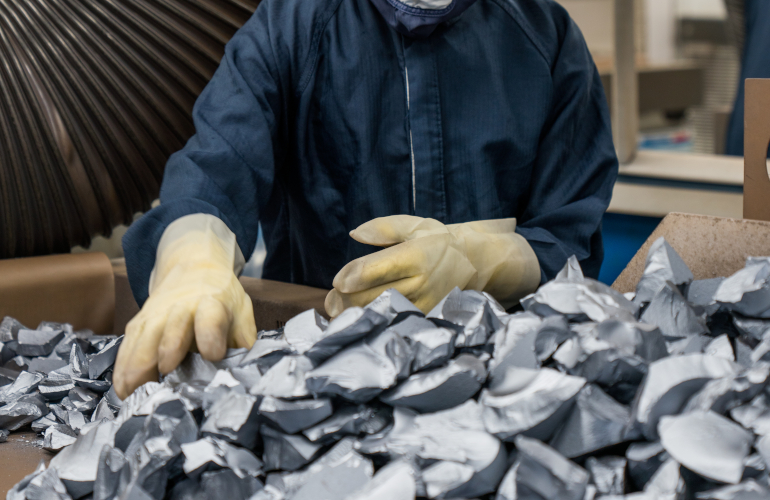
Credit: Hemlock

The Dept. of Commerce received almost 50 public comments on the matter, including from domestic solar panel players, polysilicon-focused companies and various trade associations. Most of the commenters were involved with the solar industry, although some groups commented on polysilicon’s role in the semiconductor industry, including Tesla.

Commerce was analyzing the demand for polysilicon in the United States and whether domestic production can meet such demand. Polysilicon production in the United States was essentially gutted during the China-America trade war of the 2010s. The three main U.S. polysilicon producers — Hemlock, Wacker and REC Silicon — saw their market share shrink from $1 billion in 2011 to $107 million in 2018 after China placed high duties on American-made polysilicon. China has since overtaken the global market, now estimated to hold a 93.5% market share.

Hemlock and Wacker are still producing polysilicon in the United States, both for the solar and electronics markets, but REC Silicon has since dropped out. New company Highland Materials is attempting to start a polysilicon production plant in Tennessee. There are also a handful of non-China players that contribute to the solar industry, including OCI in Malaysia and Wacker’s German plant. Intertek CEA estimates that there is only 92,000 metric tons (mt) of polysilicon capacity currently operational outside of China. Meanwhile, China’s operational polysilicon capacity reached 3,250,000 mt in 2024.

It’s generally estimated that it takes 2,500 mt of polysilicon to make 1 GW of silicon solar panels. If the United States took all 92,000 mt of the non-Chinese polysilicon supply available, that would produce just 36.8 GW of panels. The United States is averaging a 50-GW solar demand annually, showing that not only can the domestic polysilicon industry not meet the country’s solar demand, nor can the entire non-Chinese supply.

But not just polysilicon is involved in the Sec. 232 investigation — the government is looking at every product that contains polysilicon. Not only could pure polysilicon imports be tariffed, but silicon wafers, solar cells and panels could be tacked with an additional tax too.

One of the commenters, bipartisan group Coalition for a Prosperous America (CPA), suggested a range of tariffs on solar products under Sec. 232:

  • Polysilicon
    • Annual tariff-rate quota (TRQ) of 40,000 mt of polysilicon imports for trusted allied countries with non-Chinese-controlled supply chains. (Meaning the first 40,000 mt of imported polysilicon would not be tariffed.)
    • Out-of-quota imports subject to $10/kg tariff.
  • Ingots and Wafers
    • TRQ of 30 GW of ingot or wafer imports for trusted countries.
    • Out-of-quota imports subject to 7¢/W tariff.
  • Cells
    • TRQ of 30 GW for cell imports for trusted countries.
    • Out-of-quota imports subject to 10¢/W tariff.
  • Panels
    • All imported silicon solar panels subject to 20¢/W with no in-quota relief.

A decision by the federal government was expected by year’s end. Roth Capital Partners reported in late summer that PPAs were already being drawn up with “reopeners” that would allow contracts to be renegotiated based on changes to tariffs, due to the uncertainty around the Sec. 232 investigation.


Read more of SPW’s solar panel coverage here.

About The Author

Kelly Pickerel

Kelly Pickerel has more than 15 years of experience reporting on the U.S. solar industry and is currently editor in chief of Solar Power World. Email Kelly.

Comments

  1. Clinton Harbison says

    December 10, 2025 at 3:12 pm

    Does that supply of First Solar modules account for the massive number of spare panels you need to order to replace the panels that break when you look at them before trying to install them?

    Reply
  2. Brian Hansen says

    December 9, 2025 at 2:19 pm

    Great piece, Kelly! I’d like to add one caveat to the available polysilicon for the US. While it’s true there isn’t enough non-China poly available to meet the US’s demands, the total doesn’t account for the massive capacity that First Solar has. Thus, if you couple FSLR with the non-China poly, there is enough capacity to support all US installations, assuming almost all of the non-China poly is used in US modules.

    Reply

Tell Us What You Think! Cancel reply

Related Articles Read More >

Solar + storage construction starts on Project Sterling in Arizona
4-hour battery storage is cheaper to install than gas turbines all across globe
900-MW portion of Indiana’s Mammoth solar project coming online
AMMP launches AI coworker for renewable energy asset managers
“spw
 
“the-informed-solar-installer”
“solar
“spw
Don't miss a thing!
SPW brings you the must-read stories each morning in our special newsletter.

SPW Podcast

“solar
Solar Power World
  • Top Solar Contractors
  • Top Products
  • Leadership
  • Solar Articles
  • About/Contact Us
  • Subscribe
  • Advertising
  • Arrowfly LLC

Copyright © 2026 Arrowfly LLC. All Rights Reserved. The material on this site may not be reproduced, distributed, transmitted, cached or otherwise used, except with the prior written permission of Arrowfly LLC
Privacy Policy | RSS

Search Solar Power World

  • Home
  • Top Solar Contractors
  • Articles
    • Most Recent Posts
    • News
      • Latest News Items
      • SPW State News Hub
      • IRA/OBBBA coverage
      • Solar tariffs
      • U.S. manufacturing updates
    • Featured
      • Latest Feature Stories
      • Benchmarking U.S. Solar Manufacturing
      • SPW’s Rising Stars
      • Trends in Solar
      • The Solar Explorer
  • Policy
    • Latest policy headlines
    • IRA/OBBBA Coverage
    • Tariffs and Court Cases
  • Markets
    • Residential
    • Commercial
    • Community Solar
    • Utility
    • Storage
  • Products
    • 2026 Top Products application
    • Winners of SPW’s 2025 Top Products
    • Batteries and Storage
    • Electric Vehicle (EV)
    • Inverters
      • U.S. solar inverter manufacturers
    • Racking and Mounting
      • U.S. solar mounting manufacturers
    • Software
    • Solar Panels
      • U.S. solar panel manufacturers
  • Resources
    • About SPW
    • Digital Issues
    • Event Coverage
    • Podcasts
    • Product Manufacturing Locations
      • U.S. solar inverter manufacturers
      • U.S. solar mounting manufacturers
      • U.S. solar panel manufacturers
    • Solar Classrooms
    • Suppliers
    • Videos
    • Views
    • Voices
    • Webinars / Digital Events
    • Whitepapers
  • 2026 Leadership
    • 2025 Winners
    • 2024 Winners
    • 2023 Winners
    • 2022 Winners
  • Advertise
  • Subscribe