

Sugar Hollow workers assess the damage outside their warehouse following Hurricane Helene.
Sugar Hollow Solar has spent over a decade building a strong residential solar business in western North Carolina, based out of the eclectic, buzzing town of Asheville. With a warehouse at Biltmore Village — a town created to house employees of George Vanderbilt’s enormous Biltmore Estate — the business is Asheville through and through. But the 1,000-year floodwaters of Hurricane Helene threatened to wash away all it had accomplished.
Last fall, wind and flooding from the hurricane overtook Sugar Hollow’s (No. 273 on the 2025 Top Solar Contractors List) Biltmore warehouse. Cell service was nonexistent for team members in the direct area, so the first 48 hours were spent checking on neighbors, finding food and water and assessing immediate needs.
“One of our staff members lost her entire house. She swam out of 25-ft swells of water with her one-year-old child, her disabled mother, her dogs,” said Johanna Hagarty, director of marketing and development for Sugar Hollow.
Hagarty lives close to downtown Asheville, on the same grid as the main hospital. That meant she got power back sooner than other residents, but it still took almost three days. That was three days the hospital had to operate on backup generators without running water.
“Of course, it wasn’t our time to be like, ‘Hey, hospital, let’s sell solar,’ but it is the time to talk about why those things are so invaluable moving forward. Climate change is real, climate disasters are happening all over, and this is one of the ways that we protect ourselves,”
Hagarty said.
When Sugar Hollow employees were able to safely assess the warehouse, they found around $1 million in ruined solar products and tools. Luckily, they had already signed a lease for a new combined warehouse and office space that was on higher ground and unharmed by the devastation, so they moved employees and trucks there. Then they mapped out how to rebuild.
“We were able to start reaching out to Amicus Solar Cooperative that we’re part of, and we really started talking to our partners. We even had local competitors offering products, bringing things to us. So, we got a slapstick starter group of products at our warehouse, and within two weeks, we were back to installing,” Hagarty said.
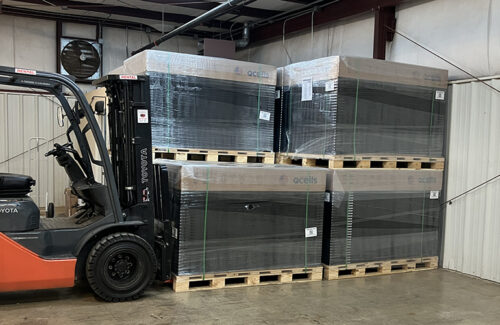
Sugar Hollow workers relocate to the new warehouse and start to rebuild inventory after the flooding.
It took time to get the full inventory back up and running. Like many in Asheville, Sugar Hollow did not have flood insurance, so most of the losses were not covered. Instead, the company applied for FEMA money and small business grants.
“We’ve got tens of thousands of dollars in small business grants that were really, really valuable for us. Our finance partners were really gracious with us. Everybody had to work with us,” Hagarty said.
Even as a stable business of 14 years in 2024, the hurricane tested Sugar Hollow’s resolve and connections. Sugar Hollow had already become a Certified B Corp in the summer before the storm. Enduring this catastrophe only sharpened the company’s focus on its people and community.
“In this rebuilding process, we really wanted to figure out, where do we fit in in putting us back together and making us healthy as a community?” Hagarty said.
Sugar Hollow started the Repower WNC Fund to increase their community’s access to renewable energy. Those funds help support the Earthshine Nature Community Assistance Program, which deploys solar-powered, all-electric vehicles to deliver supplies and act as mobile power sources in emergency situations.
Sugar Hollow also made a new commitment to donate installation work for community organizations that could serve as hubs in case of future disasters. The company recently completed a 9.75-kW solar + storage installation for The Worx Project, a career tech campus for youth in Western North Carolina.
 As far as silver linings, residential solar + storage interest ballooned after people had to endure weeks without power. Messages from current solar customers on how they were able to help their neighbors with their backup systems came pouring in during that time, too.
“One of my favorite sweet stories was there was a neighborhood and a guy had just gone on an Alaskan fishing trip. He was going to lose hundreds of pounds of fish, and he stuck it in his neighbor’s freezer because he had solar and batteries. Then, they had a whole fish fry for the community, and everybody got to eat yummy food,” Hagarty said.
Even with the potential repeal of the residential solar tax credit, Hagarty says it’s clear people who have experienced devastation like the hurricane will not be deterred from investing in renewable energy.
“I cannot tell you how many people called us and were ready [to go solar], even in the midst of disaster and crisis. They said, ‘OK, I have to solve this problem,'” she said. “From that longer-tail, I think we’re in a bit of a ‘ping pong’ with the conversation. Politically, [solar] is sort of being stripped away, but here, we just experienced such a fresh need.”
This story was featured exclusively in our 2025 Top Solar Contractors issue. See the issue and full list of top U.S. solar installers here.





Tell Us What You Think!