
By Steve Arters, director of marketing, Renu Robotics
Vegetation management at utility-scale solar power plants has always been a growing problem, especially seasonally (yes, pun intended). But with the evolution of AI technology, solar site management can be largely hands-off.
Challenges of vegetation management
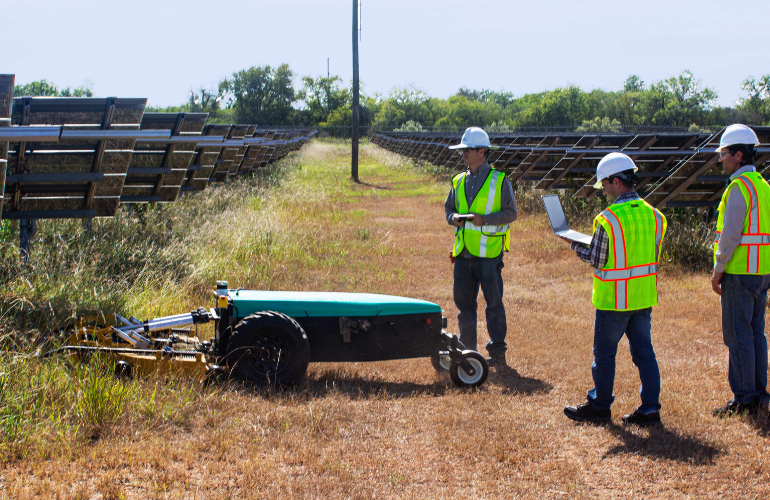
Renu Robotics
Solar plants have two primary stakeholders: asset owners and O&M providers. Asset owners typically have power purchase agreements in place for long-term profitability, so they need to control costs while keeping the facility maintained in quality condition. Steady costs mean higher profitability.
O&M providers, on the other hand, must manage cost and labor for maintenance and provide a quality service in order to keep the contract with the asset owner.
Since O&M providers are typically well-trained technicians who support electrical repairs and modifications to solar facilities, it is very challenging to find and keep low-cost labor for the dangerous, dirty and exhausting work of mowing and grooming the grounds. To keep costs down on vegetation management, it may be seasonal employees or outsourced landscaping companies doing the work.
The often remote locations of solar projects also factor into the cost of vegetation control. Landscapers may have to drive considerable distances since large solar projects are located outside major cities or urban areas. The distance adds to expense, time, carbon emissions and difficulty finding and maintaining qualified help.
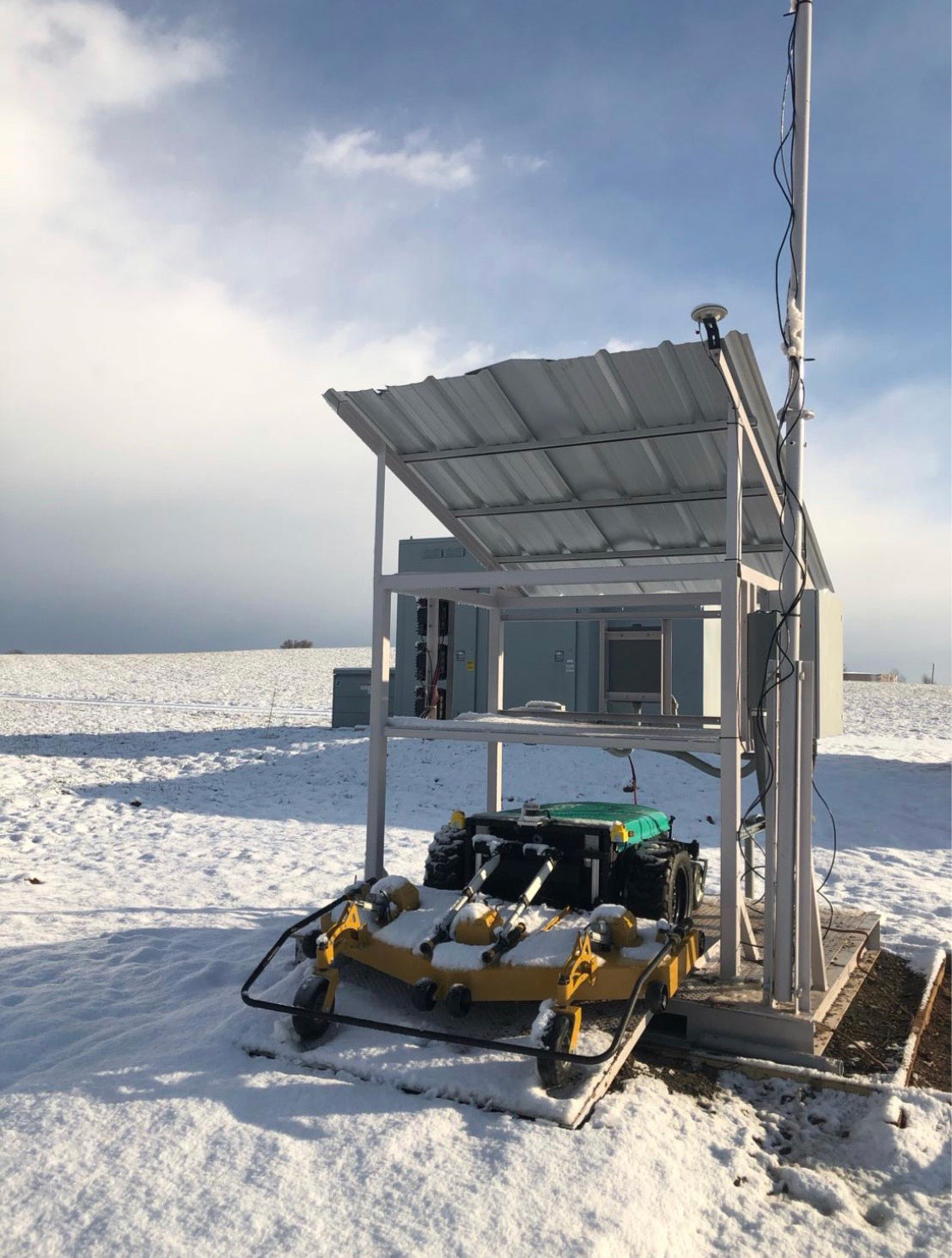
Renubot charging in it’s recharge station at a solar farm.
Operating lawnmowers and other landscaping gear within a solar project can also be dangerous. There’s a vast range of high voltage running through these projects, so workers must assume any component in the system could be energized. Crews have to undergo training and, in some instances, wear full-body safety gear and face masks in hot and humid weather.
Vegetation management solutions
An automated vegetation management system that is repetitive and reliable is a great solution for controlling costs for both asset owners and O&M providers. One such option is the Renubot, an autonomous mower that uses GPS with real-time kinematic (RTK) correction so it’s accurate within 2 cm and equipped with lidar to map the site. The Renubot is also completely electric.
Turning to an all-electric autonomous mower increases mowing time and decreases carbon emissions from fuel use. It may seem like small advantages, but those cost savings add up on large-scale sites. And there are fewer outsourced landscapers needed to maintain the landscape. In Renubot’s case, the system can be accessed by computer, phone or tablet and monitored during hands-off operation.
The future of utility-scale solar O&M
Utility-scale solar facilities will always need to be maintained. To keep facilities operating at peak performance, O&M providers will continue with vegetation management, repairs, replacements and cleaning. Renu Robotics sees a future where automation makes the process of maintaining large facilities easier and less expensive.
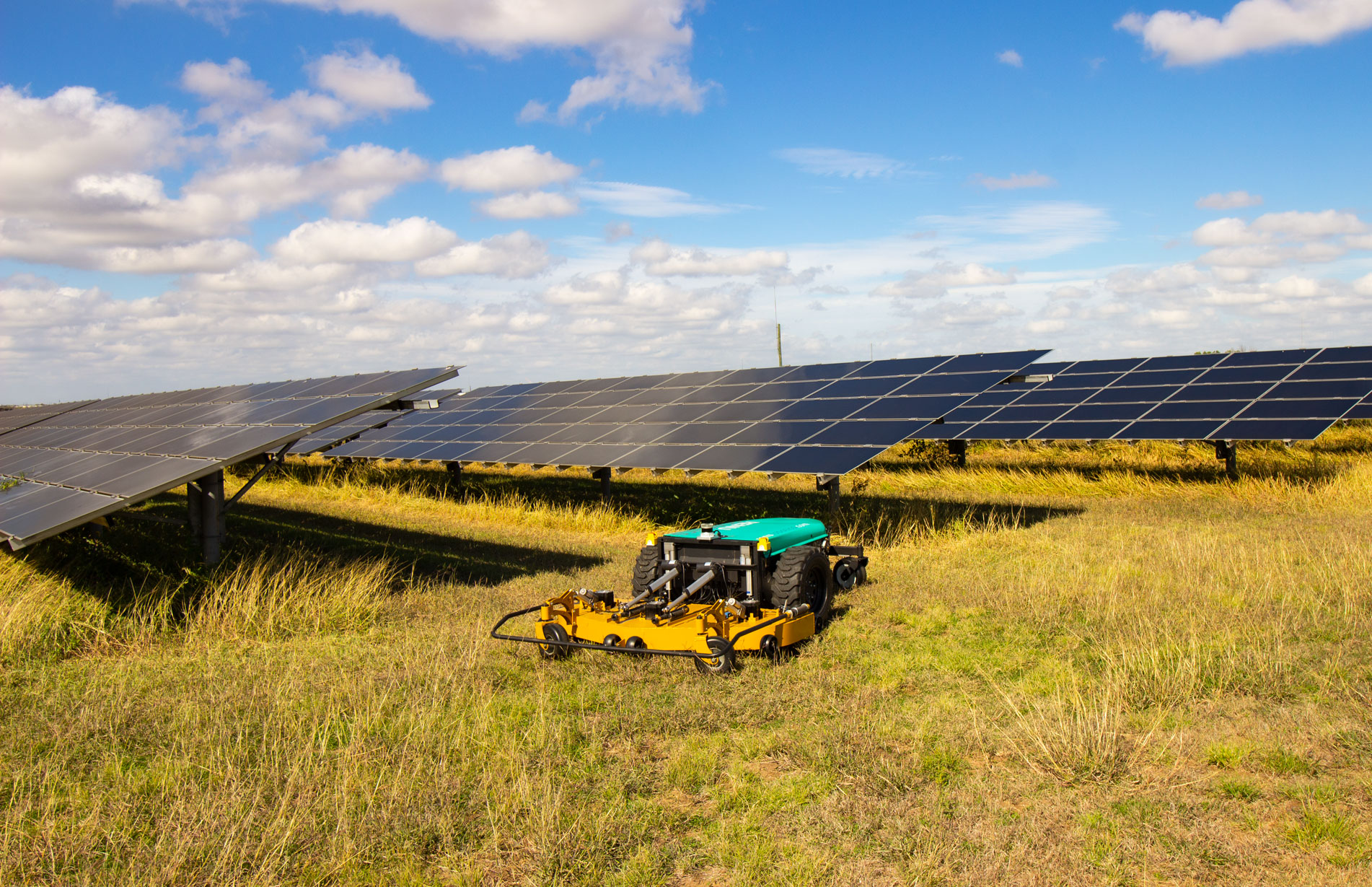
The Renubot autonomously mowing at a solar farm in San Antonio.
Looking ahead, Renu is working on an automated inspection system that can spray for weeds; locate and repair or replace failed or damaged panels, loose wiring or hardware; and perform a litany of other repairs. Another possibility is security robots running along the perimeter of a project’s fence line.
Automating many utility-scale solar project maintenance functions can allow O&M technicians to detect failures before they happen. Automation will not only play a role in keeping costs down but will also drive higher revenue when solar plants are operating at peak output performance.
 Steve Arters has been with Renu Robotics since the company’s inception, directing marketing strategy for the company, including social media and investor relations. Steve has an extensive marketing background that spans a spectrum of industries, including solar power and oil and gas. He can be reached at [email protected].



This mower looks like a quality product with some appliacations, however, as a provider of VM services with 39 years of experience and a couple thousand acres of solar farms in our clientele, I think its intriguing idea, but has so many real world challenges that it is very unlikely to be useable on a real level. Here’s why:
The terrain on these sites is terrible. Within two to three years there are ditches that make for rough mowing and would be untraversable for a small wheeled vehicle like that.
The blades need sharpening, a lot. This requires having staff that can operate the technology end and run the mechanical end without hurting themselves. This also means hot work on site (at least grinding).
There is a huge problem with mowers catching on fire because of the grass clippings. It is difficult with a crew of men to contain one, not sure how a robot would do that.
If it goes down, you could be off cycle for a month. When it comes back online, the grass and weeds will be way too tall and thick for the robot mower to handle – then what do you do? You can’t get a vendor to drop everything and come to you. Your people and equipment can’t do it safely. It puts you in a bind. Everything always breaks. From electric mowers to John Deere tractors, you have to be able to repair or replace quickly.
These machines (I’m not singling any mentioned in the article out) can cut the right kind of grass in the right kind of conditions. They can’t cut a site that has a Johnson grass or a marestail infestation. The blades don’t have that kind of power. The biggest zero turn mowers have a huge issue with Johnson grass. We have 80 hp tractors that get bogged down in kudzu. Finally, morning glory vines growing up the posts are one of the biggest issues, and that is a herbicide only solution.
All in all, its interesting and these will be machines with a place and time, but there a lot of challenges. The thing that would advance the robot mower ideas the most would be for the designers to prioritize the long term maintenance.
At some point, these sites are going to have be planned with the maintenance in mind. Everything that I see coming online has never had the maintenance of the farm for the next 20 years as a serious design consideration.
The premises are correct in terms of stakeholders, costs, profitability but keep in mind that there’s a conflict of interest for the author in that he is promoting a solution that his company offers.
I wonder how big of an area can the mower cut in one charge?
Very cool! I wonder if a sensor of some sort could be used/added to possibly identify ground nesting birds?