Solar Power World

  • Home
  • Top Solar Contractors
  • Articles
    • Most Recent Posts
    • News
      • Latest News Items
      • SPW State News Hub
      • IRA/OBBBA coverage
      • Solar tariffs
      • U.S. manufacturing updates
    • Featured
      • Latest Feature Stories
      • Benchmarking U.S. Solar Manufacturing
      • SPW’s Rising Stars
      • Trends in Solar
      • The Solar Explorer
  • Policy
    • Latest policy headlines
    • IRA/OBBBA Coverage
    • Tariffs and Court Cases
  • Markets
    • Residential
    • Commercial
    • Community Solar
    • Utility
    • Storage
  • Products
    • 2026 Top Products application
    • Winners of SPW’s 2025 Top Products
    • Batteries and Storage
    • Electric Vehicle (EV)
    • Inverters
      • U.S. solar inverter manufacturers
    • Racking and Mounting
      • U.S. solar mounting manufacturers
    • Software
    • Solar Panels
      • U.S. solar panel manufacturers
  • Resources
    • About SPW
    • Digital Issues
    • Event Coverage
    • Podcasts
    • Product Manufacturing Locations
      • U.S. solar inverter manufacturers
      • U.S. solar mounting manufacturers
      • U.S. solar panel manufacturers
    • Solar Classrooms
    • Suppliers
    • Videos
    • Views
    • Voices
    • Webinars / Digital Events
    • Whitepapers
  • 2026 Leadership
    • 2025 Winners
    • 2024 Winners
    • 2023 Winners
    • 2022 Winners
  • Advertise
  • Subscribe

EIA study examines the role of high-voltage power lines in integrating renewables

By Kathie Zipp | July 6, 2018

Share

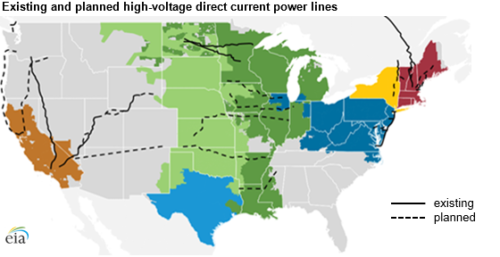
Source: U.S. Energy Information Administration, High-Voltage Direct Current Transmission Report

A study commissioned by EIA examines the role of high-voltage direct current (HVDC) lines in integrating renewables resources into the electric grid. The review indicates that, although applications in the current electric transmission network are limited, HVDC lines have a number of potential benefits including cost effectiveness, lower electricity losses, and the ability to handle overloads and prevent cascading failures. These attributes mean that HVDC lines could, if properly configured, help mitigate some operational issues associated with renewable generation.

Renewable resources can be categorized into two types of generating sources—dispatchable and non-dispatchable. Dispatchable generators can respond to real-time system operator instructions to increase or decrease output. Among renewable power plants, those fueled by geothermal and biomass resources are considered dispatchable.

Non-dispatchable renewables, such as those fueled by solar and wind energy, are dependent on the availability of naturally occurring resources. As a result, these technologies have a limited capability to respond to dispatch signals. Hydroelectric generators fall between these categories; they can typically respond to dispatch signals, but they often have seasonal operational limitations that prevent them from being completely dispatchable.

The increasing deployment and penetration of non-dispatchable renewable resources—solar and wind, for example—can lead to operational issues, such as under- or over-production of electricity during the times of high or low system demand. These fluctuations may increase the need for additional grid services to keep electricity supply and demand balanced. In addition, some renewable resources, especially wind, are geographically constrained, with the best resources located far from areas of high electricity demand.

Power transmission lines facilitate the bulk transfer of electricity from a generating station to a local distribution network. The U.S. electric transmission network consists of about 700,000 circuit miles of lines. Most of these lines operate using alternating current (AC), which is how power is typically generated and delivered to end-use customers.

Despite limited applications in the current electric transmission network, direct current (DC) transmission lines have some advantages over AC lines. DC transmission lines are more cost effective over long-distance applications, have lower electricity losses, are more suitable for underwater applications, can handle longer periods of overload operations, and can prevent cascading failures that propagate across the electric grid.

Some recent proposals for HVDC lines cite the ability to move wind generation from high wind resource areas to high electric demand areas as a primary project goal. If properly configured, DC transmission could also help minimize operational issues such as under- or over-production of electricity or the need for increased ancillary services associated with renewable generation.

The study also examined the potential costs of constructing HVDC lines. The per-mile cost of HVDC projects ranges between $1.17 million and $8.62 million, according to a review of recent proposals and relevant regulatory filings.

The cost of converter stations, which can account for as much as 60% of the total fixed cost for an HVDC project, is a major cost item considered in HVDC deployment. Other factors include regulatory issues, including siting issues; difficulty in deploying multi-terminal HVDC networks; preference for smaller, lower-cost solutions; and a lack of standardization across projects.

News item from EIA
Tell Us What You Think! Cancel reply

Related Articles Read More >

4-hour battery storage is cheaper to install than gas turbines all across globe
900-MW portion of Indiana’s Mammoth solar project coming online
AMMP launches AI coworker for renewable energy asset managers
Cedar Creek completes 5-MW solar project near closed Minnesota landfill
“spw
 
“the-informed-solar-installer”
“solar
“spw
Don't miss a thing!
SPW brings you the must-read stories each morning in our special newsletter.

SPW Podcast

“solar
Solar Power World
  • Top Solar Contractors
  • Top Products
  • Leadership
  • Solar Articles
  • About/Contact Us
  • Subscribe
  • Advertising
  • Arrowfly LLC

Copyright © 2026 Arrowfly LLC. All Rights Reserved. The material on this site may not be reproduced, distributed, transmitted, cached or otherwise used, except with the prior written permission of Arrowfly LLC
Privacy Policy | RSS

Search Solar Power World

  • Home
  • Top Solar Contractors
  • Articles
    • Most Recent Posts
    • News
      • Latest News Items
      • SPW State News Hub
      • IRA/OBBBA coverage
      • Solar tariffs
      • U.S. manufacturing updates
    • Featured
      • Latest Feature Stories
      • Benchmarking U.S. Solar Manufacturing
      • SPW’s Rising Stars
      • Trends in Solar
      • The Solar Explorer
  • Policy
    • Latest policy headlines
    • IRA/OBBBA Coverage
    • Tariffs and Court Cases
  • Markets
    • Residential
    • Commercial
    • Community Solar
    • Utility
    • Storage
  • Products
    • 2026 Top Products application
    • Winners of SPW’s 2025 Top Products
    • Batteries and Storage
    • Electric Vehicle (EV)
    • Inverters
      • U.S. solar inverter manufacturers
    • Racking and Mounting
      • U.S. solar mounting manufacturers
    • Software
    • Solar Panels
      • U.S. solar panel manufacturers
  • Resources
    • About SPW
    • Digital Issues
    • Event Coverage
    • Podcasts
    • Product Manufacturing Locations
      • U.S. solar inverter manufacturers
      • U.S. solar mounting manufacturers
      • U.S. solar panel manufacturers
    • Solar Classrooms
    • Suppliers
    • Videos
    • Views
    • Voices
    • Webinars / Digital Events
    • Whitepapers
  • 2026 Leadership
    • 2025 Winners
    • 2024 Winners
    • 2023 Winners
    • 2022 Winners
  • Advertise
  • Subscribe