

See also: What are bifacial solar modules? These are sometimes frameless!
The frameless crystalline solar module is gaining traction in the industry. Some customers prefer the way they look and how they perform. But even with their benefits over their framed cousins, frameless modules haven’t picked up much steam in the installation department. Here’s a quick summary of what’s out there and what’s holding them back.
Types
A frameless module has a pretty obvious definition—there’s no frame. A dual glass (AKA glass-on-glass or glass-glass, among other names) is also pretty self-explanatory—solar cells are sandwiched between two pieces of glass. Keep in mind that frameless is not a synonym for glass-on-glass. SolarWorld’s glass-glass module (the Sunmodule Protect) has an aluminum frame. On the other end, Solaria’s range of frameless crystalline solar panels have a backsheet instead of two glass pieces. So make sure you’re dealing with a true frameless module.
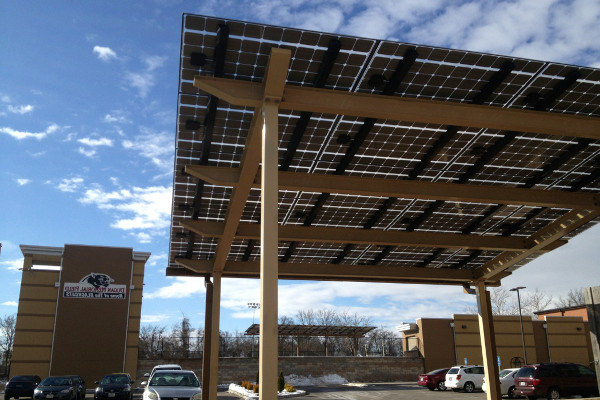
Lumos Solar LSX frameless solar modules on a carport project
Benefits
The most notable benefit is no need for grounding. Without a metal frame, frameless modules are less likely to shock workers. Frameless modules are also great for those worried about potential induced degradation (PID). Electrical current can’t leak out of a frame that isn’t there, so modules are more efficient. If it’s a dual-glass module, it has a stronger fire safety rating because there’s no backsheet. Frameless modules also provide a unique aesthetic value for customers who want to blend their solar systems into roofs.
Detriments
Why aren’t more frameless modules installed in the field? The main hold-up is the lack of compatible mounting systems. A number of mounting companies cater to specific types of frameless modules—including Array Technologies trackers and Schletter’s Eco Series laminate clamps—but they’re almost entirely for thin-film frameless modules. A few companies, such as Lumos Solar, manufacture both the modules and the racking systems and have carved out a nice niche for themselves. Lumos’s LSX frameless modules mount with their own racking solution, providing customers a one-stop shop.
Outlook
Most companies seem to be dabbling in the frameless pool but are not diving head-first. Trina Solar’s PDG5/Duo Max dual glass module has been on the North America market for more than a year. Canadian Solar will release its double-glass Diamond Module sometime in 2015. But as more and more module manufacturers announce their own frameless models, the need for mounting is necessary for market growth.
Lumos Solar has been in a class of its own for a while—offering both the module and the racking. “It’s interesting to us to see big guys now offering frameless modules,” says Scott Franklin, president and CEO of Lumos Solar. “I think they’ve all realized a few things—there’s no PID, there’s no corrosion of the frames, there are a lot of durability benefits. I think they’re just trying to find other niches and areas to push into.
“I suspect you’ll see a lot more frameless modules being used in utility-scale installations and larger installations, because they’re looking for a lower cost wherever they can. If they can find a smart mounting solution, then they can eliminate the cost of frames. There’s definitely an opportunity.”



how would these hold up to angus and other large cattle in a field ? would they need to be protected ?
I have new construction clients all of the time looking at these products and they perform very well. Great article.
Does anybody know if the frameless modules are better for marine conditions?
Absolutely, frameless modules are best for marine conditions, even-though developers do not appear to understand this. PID is one of the main issues with floating solar, causing energy leaks and a security threat on water. Frameless modules reduce that risk but also, reduce the possibility of water infiltrating the module through the bottom of the frame. PID was one of the major technical issues discussed at the Floating solar conference I attended in Singapore in the fall of 2018. In theory (outside of current cost consideration), the best frameless modules for floating solar are not glass to glass modules but aluminium back modules and not made from crystalline but CIS (CaTe is too risky if the toxic Cadmium was to leak into the reservoirs).
With thinner glass (<2.5 mm) weight can be controlled.
Thank you for reading. We will look into Silicon Energy.
Try Prism Solar as well made in New York and features bifacial technology….
Double glass modules certainly have advantage in terms PID & corrosion. It may be good for countries wherein they can adopt it as BIPV modules. But it is not so good for Arid or Semi-Arid countries as BIPV.
@Sathyanarayan how does humidity level affect glass-glass modules then?
I’d rather think temperature would more of a factor?